I'd like to call to order this regular
September 15, 2026 Board working session
YouTube transcript and recording
YouTube auto-generated transcript of BVSD’s official meeting recording. These English captions are reproduced with their original wording and timestamps. Automatic captions can contain errors; check the linked recording for exact wording. This is not a district-edited transcript.
Captured September 16, 2026. The caption track begins at 00:15:18 and ends at about 06:04:05. Caption display intervals can overlap. No spelling corrections or speaker names have been added. Capture information.
Download the timestamped transcript (TXT) · Download captions (VTT) · Download captions (JSON)
Notes on interpreting the meeting
Read 02:03:03–02:03:38 together with 02:08:19–02:08:58 before treating the resident range as an admission rule. The explanation uses some ambiguous population references; it is not a substitute for a written placement commitment. The graph of assigned-school attendance also needs to distinguish transfers between Mesa and Bear Creek from attendance outside both schools. The original resident-attendance analysis.
The spoken 85%/455 example near 02:02 should not be used as a checked calculation: 85% of 522 is 443.7. The website relies on the official slide and separately reproducible arithmetic. The captions retain their original words.
Full transcript
All 8,026 caption lines shown.
meeting of the Bowler Valley School
District for Tuesday, September 15th,
2026. Board members may attend and
participate in board meetings by
electronic means in accordance with
board policy, BMEA, and state law.
Laura, can you please call the role?
>> Booker,
>> here.
>> Chavez,
>> here. Medler
>> here.
>> Quinn Linua
>> here.
>> Raj Paul
>> here. Tamu Aing
>> here.
>> Anger
>> here.
>> Thank you. Like to encourage everyone to
turn their attention to the screens for
our land acknowledgement this morning.
The Boulder Valley School District
resides and operates on land that is the
ancestral homeland and unjustly and
illegally taken territory of the Ude,
Pueblin, Arapjo, Cheyenne, Apache,
Navajo, and 48 other tribal nations
historically tied to this land who have
called this land home since time and
memorial.
We acknowledge the atrocities committed
here, including the painful history of
genocide, forced assimilation, and
efforts to alienate the indigenous
inhabitants from their homeland,
supported by the policies of the United
States government.
BBSD is aware of the many indigenous
peoples, past and present, and their
dignified nations and cultures, who care
for this land with strength and
resilience.
BBD recognizes the histories of the land
in Colorado and the survival of many
nations that carried their oral
traditions into the present.
It is BBSD's responsibility to educate
ourselves, our community, and our
students so that we can embrace the
wisdom and knowledge of indigenous
peoples
and actively stand together to address
injustices.
In offering this land acknowledgement,
we affirm and honor the history, wisdom,
oral traditions, and resilience of
indigenous people, and recognize the
responsibility to care for and
appreciate this land together.
I'd like to remind everyone that the
mission of the Boulder Valley School
District is to create challenging,
meaningful, and engaging learning
opportunities environments so that all
children thrive and are prepared for
successful civically engaged lives. Good
morning everyone. Thanks for joining us
here in person and for those of you who
are watching this meeting remotely.
We're always glad to have you observe
and participate in our meetings. At this
time, is there a motion to approve
today's agenda? Moved by Deian, seconded
by Jorge. Uh Laura, can you please call
the role?
>> Booker,
>> yes.
>> Chavez,
>> yes.
>> Medler,
>> yes.
>> Quinn Linua,
>> yes.
>> Raj Paul,
>> yes.
>> Teamu adding,
>> yes.
Anger.
>> Yes.
>> Motion passes.
>> Board members, as you know, today we
have a work session, a study opportunity
for one item. This meeting was
originally planned to discuss our
strategic plan update. Um, and given the
extent of community feedback that we
received last meeting, we have decided
to replace that topic with another study
of the resilient schools framework. and
the draft resolution number 26-27
when we were discussing making that
shift. One thing that I just really came
to me is
when we started our work with the
strategic plan, there were a lot of
significant changes that were really
hard hard for our staff to incorporate,
hard for the system to incorporate. And
through that work,
um, we have made some outstanding
improvements for our schools. Being
credited with distinction for three
years in a row was not without great
effort, um, and faith, trust that we
would do what's best for students. And
so, um, while I am saddened that we
couldn't get an update on that because
it has been a lot of hard work and it's
something we're celebrating, I do think
it's really important to give a little
bit more time to our community um to go
through some of the questions that came
up during our last board meeting on this
resil resilient school proposal. And
with that, I will hand this meeting over
to Dr. Anderson.
>> Thank you, board president Raj Paul,
board members. Um, I want to start by by
thanking the folks that are here with us
today, folks that are watching online.
um and really appreciate our board
listening to our community and making
this adjustment. So, we had an
opportunity to get in a little more
detail in terms of some of the community
questions that we've received through
our forums, through email
communications, both to the board and
individual board members, um and through
the uh five plus hours of public comment
that we uh heard last Tuesday.
So board members, as you can see, um
today we will we'll go we'll do a bit of
a deeper dive in some of the proposals
answering questions. Encourage board
members ask questions that you have
today. Um based on those questions, then
the proposal will go to uh to to the
board for action at our meeting
scheduled for September 22nd. And so
this is an additional um session based
on community feedback and board
direction to provide more detail into
some of the outstanding questions and
hope to be able to clarify that for for
many of the members of our community
and this is what I just shared. Um
before I I uh move forward uh board
members and community members we have uh
most of our senior team here at the dis
in our work session today. Uh Rob Price,
assistant superintendent of operations,
Glenn Sigru, our senior planner. Neil
Anderson, assistant superintendent of
schools. Emma Herszog, chief academic
officer. Uh Nativity Miller, deputy
superintendent, Bill Sutter, CFO, Randy
Barber, chief communications officer,
and Jessica Azine, our executive
director of accountability evaluation.
And as we present, uh today, uh board
members, we'll be bringing up additional
members of our team uh to provide the
expertise that you'll need to be able to
ask the questions that you have around
other topics as well. uh to make sure
that um that that your questions are
answered as you consider this proposal.
Um I'll close this introduction with
knowing and understanding that um and
and and the appreciation for the level
of engagement of our community on this
proposal, the level of questions, the
level of detail in those questions. And
so we look forward to today to be able
to to begin to bring some clarification,
bring bring some things to light that
folks may maybe not have realized as
they were trying to analyze what it is
we presented on the 25th. um and make
sure that the board has your questions
answered in what I know is a really
really difficult decision uh for the
board to take uh next Tuesday. So with
that, I'm turning the presentation over
to assistant superintendent of
operations Rob Price.
>> Rob, one quick thing. Board members,
there are a lot of slides and I'm just
trying to kind of think through how to
like logical places for pausing and
asking questions. We want all those
questions to be answered. My thinking is
if we can get through the methodology,
pause for questions, look at the data,
pause for questions, and so because this
first section is pretty is quite long
before we get to a discussion slide. So
after the methodology slides, we'll ask
questions and then if that's okay and if
it's not, let me know. Thanks.
>> Sounds good. Thank you, Dr. Anderson.
Good morning, President Rashall, members
of the board. Uh we're just going to
spend a little time this morning
revisiting how we made our decisions.
And as uh the proposal that we presented
to you on August 25th did not begin with
a list of schools and we've continued to
see that around the country. This work
has really grown out of several years of
board direction um analysis by our long
range advisory committee. Uh we've
monitored, we've analyzed enrollment,
we've engaged the community, and we've
considered multiple options, all
presented to you on August 25th.
Throughout all of this work, uh we have
kept our focus centered on the student
experience and providing a high quality
and equitable learning experience to all
students and to manage district district
resources in a fiscally responsible uh
manner.
The long range advisory committee began
its work in 2022 following the board
prioritizing this work understanding the
challenges that declining enrollment was
presenting to the district and from the
beginning and as I just mentioned we've
been centered on the student experience
the most important metric that we have
followed is the number of or the average
number of classes per grade level and
for planning purposes you can see it
here at the bottom of the slide one
round is 25 students students in each
grade or about 150 students across a K5
school. That has come up on a number of
occasions. So, we want to make sure that
is understood by our community. Uh the
committee then determined that when
enrollment is equal to or less than two
classes per grade level, schools feel
the impacts of declining enrollment. LRA
also considered utilization. Uh classes
per grade level really helped us
understand the student experience.
utilization helped us understand uh
operational efficiencies and that
utilization accounts for different size
of school buildings. Um the metrics uh
as we have presented to the board on a
number of occasions really was just an
early warning system. Uh LRA um also if
you remember emphasized the need for
geographic uh consideration. So looking
at regions, we're looking at multiple
schools at once uh within the same
communities. Um the timeline over on the
right side shows the steps we've taken
to study enrollment policies, attendance
boundaries. We looked at a number of
ways to increase enrollment to avoid
this difficult conversation. And like
many districts, we have not been able to
change the enrollment patterns just due
to the underlying demographic uh trends
that we have been seeing here in Boulder
Valley School District.
By the fall of 20ou 2025, enrollment
showed that by 2030, more than half of
our elementary school schools in
Boulder, Lewisville, and Spirior, and
Broomfield were all projected to operate
at or below two classes per grade level.
And at the same time, school leaders,
teachers, families, uh, were all
reporting the effects of declining
enrollment. And I remember that
conversation coming up many times at
this board DAS about the challenges that
we were faced with in some of our
smaller schools. And for years, we
figured out how to make it work. And Dr.
Anderson has talked about this. We have
pushed in resources.
And that was workable when we had a few
small schools. It is not sustainable
when the majority of your schools are
small. We're not funded like that. We're
funded on a per pupil basis. And based
on those underlying challenges, it was
during the October 2025 work session.
The board directed us to change course.
Uh that is when you had said let's not
address this on a school by school
basis. We need to address this on a
regional approach with multiple schools
to look at. So that direction led then
to the development of the community
engagement plan that we presented to you
in January. We then started engaging our
staff immediately. Dr. Anderson, Dr. De
La Cruz went out, met with all of our
teachers during roundt meetings. Uh we
then had at six community engagement
sessions and then at seventh I guess at
the Coline community engagement session
and then as we had stated we met as a
staff over the summer to develop options
and then based on those options we
brought our proposal back to you uh on
August 25th um as stated in the timeline
that we originally presented to you back
in the fall.
I'm going to present this slide one more
time. I bet I have presented this slide
30 or 40 times
um since October, right?
I've presented this during our community
engagement sessions. I've presented this
at least three different board meetings.
I've presented this at every municip
every every presentation municipalities
uh district advisory committees. I think
we had 14 of those and in a number of
written communications that have went
out to the community. So, I'm a bit
surprised why everybody is surprised
with the uh option or the proposal that
we brought forward to you. The proposal
is within alignment with all of the
options that we told the board we would
consider. So, uh what we um consistently
communicated was this full range of
tools that districts use throughout the
country when they're dealing with
declining enrollment. As I talked about,
districts go through the same thing.
They find out how how to make it work.
They push in resources. Then they shift
to let's figure out how we can increase
enrollment. We did that. We had the BBSD
this place to be showcased. We tried to
generate additional enrollment. We have
a commuter preference that we no longer
had. We slowed declining enrollment for
a bit, but again, there is no way to
address the underlying demographic
trends. The housing prices that we're
seeing in Boulder Valley School
District. Young families can no longer
afford to live here, right? and that's
why we're seeing what we're seeing. So
again, just for clarification, the
resilient schools proposal that we
presented to you on August 25th utilized
the options on this slide. And again, a
lot of these options were prioritized by
our community during the community
engagement sessions and during some of
the surveying and polling that we did.
Um, and with that, I'll turn it over to
Randy Barber.
So, following the board's direction, as
as Rob mentioned, as well as the plan
that we uh brought to you in January of
2026, uh we hit the road. Um our
philosophy has been listening before
leading. Uh we wanted to first connect
with our elementary school staff, so our
principles, our teachers, and staff at
those schools through roundts. Um you've
seen the slide before, but now with a
little bit more uh imagery, just again,
we were out there, we've got uh we've
got photographic proof of that.
um 14 presentations, advisory groups, a
lot of the places that that Rob was
talking about where we presented this
the plan, talked through the different
options that we had for folks. Uh we did
the same at the seven engagement
sessions that he mentioned and we went
to our city councils. We really wanted
to make sure that our m municipalities
were aware uh really be being following
along with what's going on here.
Obviously, these things are going to
impact our cities and we wanted to make
sure that they had an opportunity to
hear what our our game plan was and in
some cases they provided some feedback
to us in in regards to their thoughts on
it.
Next slide. Oh, and then we also had a
survey that we'll talk about as well.
Uh, a big part of this was
communication. So, since the beginning
of the the process with LLR, uh, I think
we've got something like 30 stories that
we've done on the district side of
things in regards to this process. every
time that we had an update, we were
coming back to the community and letting
them know where we were at. As we went
through the attendance boundaries, we
were doing stories upon that. And then,
of course, things really ramped up after
that January plan came out right in
February. Uh and since then, uh we have
been uh doing uh updates uh to the
community through a newsletter uh seven
of those uh throughout throughout time.
uh those were really action-packed with
with all the information that we're
talking about the plan uh opportunities
for engagement, really encouraging
people to participate. We were really
reaching out to folks, letting them know
about the regional approach to it,
letting folks know again about the
options that we had on the table here.
Uh we also had a good amount of uh
earned media coverage. Um you know,
throughout uh our all of our media
outlets in the the Metro Denver area,
they've covered it. uh but most
specifically our local paper of course
would be the heaviest uh with seven
stories uh covering both the regional
and the options that we had on the
table. So uh that has been out there in
the community uh as we've been talking
through it. I do want to just mention
that this this work for my team uh while
we've done a lot of things uh that are
that are tough. Uh we obviously had the
Marshall fire that was uh you know
incredibly hard in terms of crisis
communication. Uh we went through the
pandemic and that communication was
incredibly hard. Um this was a whole new
area of uh of learning for us. Uh you
know we had never uh gone through a
closure uh like this and so with the
board's suggestion um we were able to um
bring in a couple consultants to give us
a hand with this. Uh Planfully is a is a
a couple ladies that have gone through
this at Jeffco uh through Jeffco public
schools uh had really lived through the
process and they're communication focus.
So, you know, they were able to give us
some real insights into how to best
approach community relations in this
instance, uh the kinds of communications
that would be needed uh through this.
And then um on the back end, uh uh once
the decision was made, we brought them
back in to be able to have some
conversations and actually give us a an
extra pair of hands in drafting some of
the communications that we used. uh as
you can imagine there's quite a bit of
things that we had to prepare and so
having some extra uh communication folks
um you know at our ready was really
helpful to my to my team. Additionally
and I I know everybody in the community
that came out to our engagement sessions
saw the work of ERS but I want to really
uh highlight uh what their what their
role was in this. As we went into those
engagement sessions our team was really
thinking about you know we didn't want
this to be the normal uh feedback
sessions that we had 20 years ago. We
didn't want this to be what we see
around the country. We wanted to do
something different. And so again, with
that idea of listening before leading,
we our philosophy was a how do we
introduce folks to the information that
we're talking about? Uh give them a
sense of what it's like to be in these
schools when you've got uh students and
staff that are being impacted by
declining enrollment. That's, you know,
tough. I mean, we could showed a video.
We could have done a number of things,
but by giving uh them exercises in order
to see what that feels like, uh it was
really helpful. a whole lot of parents,
you know, could kind of really then
understand uh kind of visualize what
that experience was like. And then we
really put them in the driver's seat and
thinking about these different options
and having uh throughout the process
we've said that one of the big things
that we really wanted to hear and
something that uh Jessica is going to
talk about in a minute is really, you
know, we wanted to be able to hear from
folks what their priorities, their
values, you know, how they were looking
at these things, the things that really
were most important to them. And so at
these tables and it was I I find amazing
to watch the engagement that happened
here. Uh parents uh some students we had
a a small number of students come out.
Um they were really debating and
weighing these different things and I
think everybody that came to these
sessions said you know there was it's
difficult work. I mean we'd like to
prioritize all the things that we're
thinking about here. And I think that's
the difficulty that we as a as a
district have. And so these cards that
they created, the tabletop exercises
really help people to be able to have
that experience of of being part of the
process, thinking through these things.
And then part of this was actually
trying to encapsulate trying to
understand and document that feedback.
And so of course we had our principles
at the tables. And so they were
facilitating this and writing down what
they were hearing. And then each of the
participants was able to in a packet be
able to write down their feedback as
well. And so all that was captured and
then ERS took that data, compilated it,
tabulated it, and then was able to hand
it off to us. Uh before I hand it off to
uh Jessica Aine, our executive director
of accountability and evaluation to talk
more about how that process worked once
the data was handed off, I do want to
just make a really important point,
especially based on some of the feedback
that we've heard in the community, that
neither of these two consultants, truly
no consultants were in the room when we
were making these decisions as
leadership team. uh we came together um
you know that work had already been done
in regards to the engagement and uh in
those rooms it was district leadership
that was really weighing considering the
data and then making those decisions. So
the the consultants were not part of
that.
Just one other point, board members. Um,
and thank you, Randy, and thank you,
Rob, um, for sharing. You know, in my
nine years here as superintendent, I
don't know that there's been any topic
or any moment in time where our
community has had more opportunities for
engagement and communication from the
district than the process that we just
went through. Um, uh, Dr. Dr. Alzine
will will talk you through the the the
statistical analyses that we we were
able to recover as a result of that. But
board members, we anyone and everyone
who wanted to participate in um in these
processes in these work sessions, we
accommodated uh we shifted venues just
like we did last week when we knew that
we had more folks that wanted to talk to
us than we potentially had room to be
able to to accommodate in a way that was
respectful and meaningful. Um, we
originally planned having these sessions
in libraries, then we moved them to
gymnasiums. And I just want to thank our
team for all of the things that they did
to make those um those opportunities a
reality. But it gave us really clarity
on our community as a whole, what
they're looking for from their
elementary school student experience.
uh the the data and you'll see as we
talk about the survey data and we talk
about the community polling data and we
talk about the teacher data that we
collected uh triangulated in a way that
gave us a really clear picture on what
it is we were trying to do as we began
to develop this proposal. Uh so I I I'll
share that I'm very proud of the process
that we used. I will share that I'm
proud of the ways that we tried to
communicate and I think the trick with
communications is and even engagement is
to the extent that you can put forth the
best effort, it doesn't mean that it's
100% guarantee that that everybody is
able to participate or is is able to
engage in that. And that's just human
nature and that's just kind of I think
the reality in any big decision that
that school districts make is that you
know we're going to put for our best
foot forward and really try to do what
we can. But I will say that uh the ways
in which we engaged the process that we
used uh I think was was really a a great
opportunity for lots in our community to
learn about our challenges. That's one
thing to say watch board meetings. It's
another thing to come and sit for three
three and a half hours with a
facilitator know and understand the
experiences that are happening across
the district that might not be your own
experience. Right? that that that you
know as as we solve for these things we
have individual experiences and then we
have the collective experiences that
we're trying to provide. So um I will
say that that the feedback that we
received at the end of those of of these
um these sessions was incredibly
positive board members. You were there
you heard what I heard. folks were
really appreciative that we listened and
heard and so um just as establishing
that that those that that engagement
that data that feedback very very
important as we developed our proposal.
So
>> before we turn it over to Dr. Elian I
wanted to see if board members had any
questions on the timeline u methodology
up until this point of the presentation.
Elena,
>> first I appreciate the clarification on
consultants. I've had a lot of questions
on that. Um, so thank you for sharing
that. Um, and I'm curious on
the timeline. Did we ever change the
timeline for voting on this? Did we ever
move it up?
I I I just I can't remember and I and I
didn't know if there was the answer to
that is yes. the answer to that. Can you
just explain to me? I thought maybe it
was an open enrollment thing, but I
>> No, we we had originally um shared I
think it was October 8th for the vote
and in board discussion. I think some
really valid points were brought up on
um the potentially negative impact that
could have on individual families as
they were trying to access our open
enrollment process that that window
would be too tight. And as a result, to
make sure that we're supporting
families, given, you know, the the
magnitude of this decision, the board
elected to move that back to the 22nd.
And I believe that was at the June 9th
board meeting.
>> Yeah, it was during the board work
session, our prioritization meeting.
>> And I'm certain I was at that session,
but I did not remember that when someone
asked me that. Um, though I assumed it
was about open enrollment and and that
window there. Okay. Thank you,
>> Deian.
because I'm a relative newcomer on the
board, I uh kind of walked in and some
of these decisions were sort of in
progress. And so if I'm asking questions
that are just um history that happened
right before December last year, please
uh help me fill in the blanks. Um when
the decision was made to go to a
regional approach
um
how were those regions defined and who
defined them?
Well, the regions were well one of the
outcomes from the October meeting was
the board had told us that allowing
schools to stay small is no longer an
option. And by that time long range
advisory committee had uh presented two
different metrics and those are the
metrics are average classes per grade
level and then the utilization. So
average classes per grade level we knew
that uh the student experience was being
impacted when they got less than two
rounds. So that defined what a small
school was is anything equal to or less
than two classes per grade level. So we
knew that allowing schools to stay small
was no longer an option. So then we
looked at the different regions and in
those regions, Boulder, Lewisville,
Spear, and Broomfield, at least half or
the majority of the schools in those
regions are at or below two classes per
grade level. So that's what defined it.
We saw some growth in Erie. We saw some
growth in Lafayette. And then the
mountain schools were not included just
due to their unique geographic
locations. So,
>> uh follow-up question would be um so the
regions were um
uh were set really by geography
>> and yet it appears that there a region
that would have included all the
students that are all of the schools
that are trying to do second language
instruction that they were sort of not
in a region because they're separate.
We're going to speak um in more detail
on on the recommendation to study this
the schools that are in dual language.
Uh you when we did not identify
Lafayette, you'd be correct that we
would then not have been able to
consider Pioneer or Anjivine Middle
School. We also limited this to the K8
uh schools in um in Lewisville Superior
and elementary schools. And so Casey
Middle School, Manhattan Middle School
also wouldn't be part of of this
analysis. And so uh challenging because
certainly um two of our dual language
elementary schools are are in the middle
of Boulder. Um but we will speak to kind
of more detail on in regards of why we
we recommended to take a year to study
that. um really studying that as a K8
continuum, not just elementary schools.
And really thinking about systemically
the experience, the student experience
that we want our students who are
studying or participating in dual
language program schools to have. And
through the engagement process we had,
uh there wasn't specificity around dual
language schools and programs. uh and
their instruction and their experience
is vastly different from students that
are in our monolingual schools that just
teach in English.
>> Anna,
thank you. And for a timeline, one of
the biggest pieces of feedback that I've
received is um folks did see the uh LRAK
recommendations that uh kept coming out
on um school consolidations and where we
were at in elementary schools. And I
think that some of the the community
members um that really showed up to our
community engagement sessions were of
the schools that were in the red that
had some of that notice put into some of
those plans. Um
and now that we have announced the the
consolidations that we are looking into,
I wonder uh my my biggest question is
where that shift happened of um looking
at the recommendations of ELRACK um and
then switching to what we have now um
within that timeline for community
engagement. Um just getting a clearer
sense of what when that shift happened.
Um, and I know that right uh right now
is that that moment of uh where our
community members are able to give um
that feedback on our proposal. Um, but I
also just want to go back to acknowledge
um just the fact that some of these
parents um and community members,
families um hadn't engaged as much
because they weren't um considering that
they were going to be uh put in this
proposal for a consolidation or a
closure.
>> Uh thank you for those questions. A
couple clarifying points. Um,
we had broad community participation at
Broomfield High School, at Boulder High
School, here at the Ed Center. Um, we
Monarch High School, uh, gymnasiums
filled with individuals and they were
not limited to the schools that were
identified in the in the engagement
phase. um in the LRAK metrics that we
released as part of the annual report um
on LRAK declining enrollment annual
trends report that is per board policy
that we presented every February. And so
um because we would only have had two uh
small elementary schools participating
if that would have been the case. And so
um I do understand that that there are
some folks who didn't participate in
that opportunity or maybe didn't
participate in our surveys um that um
that at this point uh maybe didn't
realize the u the magnitude of that of
that opportunity. And uh this is why we
went through what what Randy shared
which is uh you know we we were we're
sending monthly updates to all of our
families in communications. We weren't
we weren't hiding the fact that this was
a regional approach. It was very much
front and center on why we were actually
doing the engagement process. Uh and in
any engagement session uh not every
parent participated, right? We had we
had a pretty good showing thousands you
know thousand people. I mean I think
that you know when Jessica will speak
you know when you look at all the
individual data points 76,000 data
points which we feel is a a really
strong sample and we'll talk about that.
Uh so uh so so there are people who
didn't participate in that right but if
they were to have participated without
knowing their school is named would they
have said anything differently than the
sample size that we collected from all
of these communities. The data we've
suggested is is incredibly triangulated
and clear. It's not really fuzzy at all.
Uh so that process wasn't about
individual schools and it wasn't an
engagement process per LRACK. that was a
community engagement process on the
student experience and I think that we
were incredibly clear about that. So um
and and as Rob shared, you know, we've
really tried to engage in ways that are
very honest and transparent in terms of
the of of what the board shared, what
your direction was, and how we
communicated that to our community and
the staff. And you know when it when
when when you all shared in October 2025
we need to move to a regional approach.
As superintendent I asked you for
several months to think through what a
strong process would be. How do we
create a worldclass process that listens
to people before we just behind closed
doors pick a list of schools and roll it
out to the community and ask them if
they like it or not? or even worse, when
we did this in 20 or 2003,
put out competing proposals and then ask
communities to come and give feedback on
whether or not we should close this
school or that school. Proposals that
competed directly with who was going to
be closed. And I've talked to board
members from that era. I've talked to
staff members. I was in a meeting
yesterday with a teacher who was part of
that. Uh it was horrible. Not that this
is easy. I'm not saying this is easy.
And I'm not saying that this um isn't
hard. Uh however, I think we were really
clear on what our task was. We engaged
thoroughly. Um we, you know, as as part
of of doing this, I've had a lot of
conversations with a lot of districts
across the country and I've asked them
what's their process.
Our process stands out as one that is
more inclusive and more engaging than
other districts. And you could compare
what we've done and our our um
engagement to any other district in
Colorado. I tell you, we I I promise you
our engagement has been the deepest. Our
outreach has been the most proactive. Um
so I do understand at you know folks who
are engaging at this point may have some
questions about the process. I stand
behind the process and our team who
built the process. I think it is not um
just an effective process for your
decision, but it is something um that
that should be stood up as a model
across other districts going through
something that is incredibly incredibly
difficult.
>> Alex,
>> yeah, I guess I have a comment and then
a question. Um I would just say actually
in partial response to my colleagues on
the board, uh I campaigned and um came
into the board very interested in moving
to a regional approach. Uh I live and my
kids attend schools in the Table Mesa
neighborhood and the LRAK approach would
treat Mesa Elementary as a totally
different thing than Bear Creek than
Community Monastery and Creekide. And
the parents in that community treat it
as the offerings that are within walking
and biking distance of their houses. And
so if you just looked at the LRAK thing,
you'd be we were parsing out differences
between uh small differences in
enrollment when to our later point most
of them were underenrolled. So, we
needed to act more and we're acting as
if one school because Heatherwood was a
little smaller than the next school that
Heatherwood's obviously the one that
should change and it's all on them and
we'd put all our resources into solving
Heatherwood. So, we give spend a quarter
million and what do you know? It adds
six kids in enrollment to the school.
So, it just doesn't really work and it
doesn't serve the community. So, uh, my
memory from when the board suggested
moving from the LRAK to, uh, more bold
action in part was because we knew we
needed to act substantially and that we
shouldn't act on schools in isolation.
Uh, we didn't want to go back to 2003
or whatever and pit one school against
another. We wanted communities to talk
about how best to serve the all the
schools in their in their communities.
And we're not just Boulder, like we're I
forget how many geographies we serve,
but it's a lot of government
institutions and counties and stuff. And
people do sort of work within their
community. Some will commute a half
hour, 40 minutes to a school, but not
many. Most people want to make it
practical. And so I am a strong believer
that the move from the individual school
parsing out small differences to having
a regional approach was something the
board uh I'm argued for it. I found that
the rest of the board u many of the new
people were agreeing with that approach
and that it is more holistic and
comprehensive and from the feedback that
we get I think we we see that that's
probably necessary and it leads to a lot
of transition planning. Um the other
thing I would just say is that the the
LRA the the issues we were dealing with
collectively with all 27,000 kids were
before us all the time and that the
shortcomings were not hypothetical or in
the future. they were kid families
leaving the district now for private
schools or homeschooling because uh they
couldn't get the services they needed uh
for their neurodeiverse kid in the place
where they were or that there was no
acceleration available because they had
to do advanced courses uh online rather
than in person and their kid couldn't
learn that modality. So like the
shortcomings were real. the school
by-school approach was really a short
service to our community and I for one
on the board didn't not want to wait
four or five more years of waiting for
those numbers to creep even lower. So I
I think the red and orange stuff is
helpful, but there was no green there.
Like all those schools, so many of those
schools are under enroll to the point
where they were harming kids. And I
think that's where the board I've heard
feedback from the community about, you
know, the transition from the LRAC as if
they were the policymaking body. This is
the policymaking body. We're the
decision makers directing where we go.
and we directed the district to move in
a more regional comprehensive holistic
approach and to accelerate the action so
that we wouldn't be waiting four or five
more years to pull the trigger and just
punt it off to some future board when
kids are suffering today. So I just
wanted to explain the regionalism for me
from for new members on the board who
weren't there during some of those
discussions. That's that's where I was
coming from and that's how I remember
those discussions. And one more thing on
the uh there's been the discussion about
the engagement. Um, I think it's wrong
to frame what we're doing now as like a
short version of engagement versus this
other stuff. The other stuff we did is
in addition to what districts normally
do. Most of the districts would do a
short version of what we've done in the
last 8 weeks. That's what community
engagement is at the best case in our
surrounding districts. In St. Green, I
think they had like two weeks notice
before they closed an elementary school.
Jeffco had their LRAK thing and they
went to just quick action and proposed
closing you know 11. Um so I think our
large engagement process which I look
forward to having described in more
detail now is in addition to what is
actually a normal district engagement
process with a fairly normal district
timeline that we've been engaged in in
over the last 10 weeks. That's the way I
see it. And I never expected the the
deep community engagement which I found
also great greatly gratifying to see the
sophistication and the engagement and
the deep dive of our families and our
educators. Um but that was not to avoid
having the discussion we've had over the
last two months. That was to inform the
discussion for the whole community that
we're now engaged in. So it's not an
either or or the right or the wrong way.
I think we did an additional step that
was very necessary and appropriate.
Before we move on, I just want to again
provide context to this timeline. I have
been on the board for five years and
we've been talking about declining
enrollment since I was elected in
November of 2021.
Before that, I was on the district
accountability committee and we were
talking about the impacts of declining
enrollment on student learning
experiences and student data. So, it has
been a long time coming and I understand
particularly for parents of
kindergarteners or elementary school
student or first graders who haven't
kind of been along for the ride with us
in the same way or haven't watched the
experiences at their individual schools
deteriorate over time because there are
fewer and fewer students. Um, I
understand that this feels like a
surprise and I just really hope
everybody hears how long me personally
on this board and representing on school
accountability committees and district
accountability committee before that
have been considering declining
enrollment relying on Glenn's data. I
mean, I first looked at your enrollment
matrices when my senior was in first
grade. It's been a long time coming. Um
so I I just want to share that and also
share
re-emphasize that the board which does
change every two years roughly on the
composition we directed we told staff
schools could not stay small. We asked
staff to come up with a plan. It wasn't
consultants or something else that said
we're going to close schools. You should
close these schools. We said schools
cannot remain small. Present us with
options that meet the needs of our this
entire school district. 500 square
miles, 27,000 students, and 4,000
employees.
That was the cadence
we directed. That was the cadence that
was taken. Um, so I just wanted to
clarify that as well. And then I'll turn
it over to Dr. Aline or Dr. Anderson.
>> Just one point of of clarification
because I think that there's uh, you
know, words really matter here. um when
you state options, options for each
region, not multiple options for each
region to be considered. And so, uh the
direction was clear that that wasn't
specified on October 20 25th or January
or in any any point in time during this
process that the board directed staff to
come up with multiple options for
consideration. I just want to be really
clear about that. um that it was to look
at each region and options for each
region, it would come forward in one
proposal. So, just wanted to make sure
that I clarify that uh board president
Rajbo. And with that, Dr. Azine, uh
we'll turn it over to you uh to um get
into our data sources and some of the
analysis that we did.
>> Okay. Uh so when we talk about all of
those opportunities for our stakeholders
to provide feedback, you can imagine
that we amassed a pretty robust u and
varied data corpus of data. And so this
table summarizes what we had to work
with. We had the feedback from the
teachers at those elementary roundts. We
had community engagement feedback
packets. These were packets that
individuals who attended those sessions
filled out during the evening and
submitted at the end. There was also a
follow-up survey that was offered to
attendees via QR code as they were
leaving that evening. And then we had
our resilient school survey that we
offered to the full census of every
staff member and every family currently
affiliated with BBSD. And it was also
offered to a random sample of community
members not currently affiliated with
the district but residing within
district boundaries. So as Dr. Anderson
stated this we had the 63,000 responses
ultimately 76,000 bits of data and
before I walk through this findings I
want to ground us in the scope of this
data and kind of give a little bit more
background on the methods that we use to
turn this table into the information
that was used to help support and inform
the proposal.
So we uh conducted several sensitivity
analysis and checks uh with this data
just to make sure that we felt confident
that this was a round representation of
what the community wanted and what they
valued and what they prioritized. So
first of all um as Dr. Anderson said
these were open to everyone. We didn't
turn people away and that extended all
the way to the resilient school survey.
uh rather than sending that to a random
sample of individuals that would have
guaranteed or at least better protected
against unresponse bias, we wanted to
make sure that everyone had the
opportunity to provide feedback via the
survey in particular, well across all of
these. So, uh I want to talk to this 9%
response rate from families and make
sure that we uh know that there were
some sensitivity checks done to to check
in on the validity of that being
representative of what our community
wanted. So first we looked at the
response rates across regions. So that
9% of families overall worked out to
about 7 to 11% by region. So that means
that no single region is driving the
results from the survey from the family
viewpoint. We also looked at we'll talk
in a minute one of the items or or
sections of the survey was where
individuals identified their top three
musthaves. We looked at that list by
role as well as by region to see if
there was great variability there. there
was some limited variability and all of
those results were presented to the
board in June as well as what was used
to inform the proposal. And then
finally, just to talk a little bit more
about this community survey that
occurred, we uh contracted out with
Mellan Strategies. It's a local polling
firm. So they are who ran that was a
stratified random sample in the
community to ensure that it had
representation across the district. Uh
and they ran analysis separate from the
analysis that we ran internally. and we
looked at their results compared to what
we saw within the district. Again, a
little bit of variability, not nothing
that was extreme. And all of that was
used to inform the proposal, to inform
the information that was used to inform
the proposal.
So, that's just adding to the validity
of some external validity to what our
internal results showed through that
survey analysis. And then as was said,
we triangulated across all of these
different data sources to make sure that
we were again trying to provide the most
full picture of what we heard from
individuals across roles, across
regions, across these opportunities for
engagement.
Okay, so talking about the survey, the
resilient schools community survey had
two primary sections. The first section
was this what's referred to as max diff.
This is where there was a predetermined
set of 12 priorities under consideration
when thinking about schools experiencing
declining enrollment. Individuals had
nine items where they saw four random
priorities and they had to identify what
was the most and least important from
those four. They repeated that nine
times. We heard from the community that
this this felt really frustrating that
we they were being asked to identify
most and least important from a list
where everything was important and that
we recognized that and we named that.
That was by design because that is where
we find ourselves needing to move
forward and make some decisions. We
needed to know from our community given
limited resources what is the relative
ranking of these priorities and that's
what this form of survey design allows
us to do. So head and shoulders above
the rest within our community, small
class sizes was the number one priority,
but these six are the ones that rose to
the top from the fullest of 12 as being
the most likely to be chosen as most
important across all survey respondents.
When we go to the second part of that
survey, that next part was after they
had those random sample of items, they
saw the full list of 12 and individuals
could select up to three as their top
three musthaves. And these were the top
three that were pro uh identified across
the sample.
Oh, sorry.
Next, at the community engagement
sessions, one of the activities that
people were invited to participate in
was that collaboratively at their
tables, they learned about challenges
that schools experience uh when they
have under enrollment. and the tables
worked together to collaboratively
identify those difficulties that they
wanted the district to prioritize to
solve when the proposal came forward.
And these are the top five of those
cards that were identified as the
problems that the community wanted to
see solved. And then lastly, doing some
qualitative analysis through the roundt
discussions. Uh the top two themes that
came up most often in those
conversations with staff were problems
related to small class sizes as well as
uh challenges related to part-time
staff. So when we look across these
data, we kind of quickly see some themes
show up. Uh small class sizes as well as
challenges related to variable class
size or small class sizes came across as
the top priority across all of these
data sources.
Next, we saw some emphasis for
challenges related to part-time staff.
So, our our uh stakeholders really
emphasized they wanted to see full-time
comprehensive staff in every building.
And then finally, uh equitable funding
and neighborhood proximity were also the
most likely to be chosen as uh top
priorities from the community.
And then lastly, at the community
engagement sessions, one of the
activities in the packets as well as
conversations that happened at the
roundts was when given a list of options
that the school district could take to
solve these problems. Uh what would be
the highest priority? What would be the
first choice? uh or specifically I
believe this action is a move in the
right direction to solve the challenges
of underenrolled schools is how
individuals responded from both the
community engagement sessions and the
roundts consolidating schools was the uh
most chosen top priority in those shifts
there at the community engagement
sessions the second one was to
reconfigure PK8 schools
>> Dr. Charlesine, can you go through all
of those the um how all of the the uh
the options that folks considered? You
you gave the top two. Can you just kind
of run through the rest of those? I
don't know that that's on the slide, but
I'd want that to be on the record.
>> Yes. Uh so the top was um consolidating
schools, second being the PK8 split,
third was close and redistribute
students, fourth was relocating for
focus programs, fifth was to reconfigure
or split K5 schools. And then uh final
was introducing new focus programs.
>> All right, the next part Glenn Sigru,
our senior planner, is going to be
presenting some of our methodology on
how we determine projections. Uh all of
you around this table know Glenn, but a
lot of people in our community don't.
Glenn has been doing this work for this
district for 19 years. Uh, and if you
have followed any of our enrollment
work, it has been extremely accurate
over those 19 years. And I would say it
took something like a uh, global
pandemic
to throw those projections off. And
that's about the only time that Glenn
has been off. We have a lot of people in
this community, extremely intelligent,
that are looking at numbers. There's a
lot that goes into projections. And
Glenn's going to get into that a little
bit. Uh, I'll jump in if need to, but
um, and I've got a tremendous amount of
confidence in Glenn's numbers, and it's
not about me. We can go back year over
year over year and look at our, uh, uh,
enrollment projections to see where
Glenn projected and where we actually
landed, and you would see that for
yourself. So, with that, I will turn it
over to Glenn to present our
methodology.
>> Thank you, Rob. Um,
let's get the right slide.
So our methodology uh these are the main
data sources used in most current
planning projects and the resilient
schools initiative. Uh the student
records are the primary source for trend
analysis and projections. These records
are universal meaning they are pulling
data from actual records not estimates
or extrapolations from outside sources.
Also, these records are by address and
can be aggregated in multiple ways,
usually by attendance area, but other
ways are possible as well. This is
important for school districts because
most outside data sources aggregate at
the county or municipal levels, uh,
which do not align with BBSD's
boundaries.
The next category there, the Colorado
Department of Health and Environment,
you need to go
one more. All right, there we go.
>> This one. Okay,
>> data sources. Yes,
>> our methodology.
>> Data sources here.
>> Methodology. Okay,
>> apologize.
>> Okay,
so uh every student is guaranteed a seat
in the neighborhood school. Um so this
is based on our resident populations as
the starting point for our projections.
Colorado law allows parents to apply to
attend another school only if there is
available space and programmat
programmatic capacity. Resident student
population and housing stock data is
less variable and more predictable than
parent choice uh which is a large
component of open enrollment. Open
enrollment is the valve that we can use
at times to fill space in neighborhood
schools once we account for all of the
residential students. Okay.
So, moving on to our data sources. I did
discuss
uh uh the BBSD student records is one of
the is the primary source that we start
from. We also use department u of health
and environment uh data birth data which
is primary to establishing kindergarten
class estimates uh and also just general
tren trend analysis as well. Parcel
records and development referrals from
local governments form the basis of
housing estimates uh estimates found in
projections and student generation
rates. These are also fieldverified with
periodic site uh visits to to make sure
that uh the the the data is accurate and
that it's timely because sometimes
there's quite a bit of a lag time
between some of the data we get from
parcel records for example uh and when
we actually need it.
Other outside data sources are useful
references and can be valuable for some
uh projects especially redistricting
data uses a lot of census data and state
demography data but otherwise these
sources uh can be tricky to use since
they don't align with our boundaries as
I mentioned earlier and are frequently
frequently not timely enough for
district use.
So moving on to
the enrollment projections themselves.
Uh the district uses a cohort survival
uh method which is the principal
technique. Uh it looks at seven years of
historical data resident student data by
grade for a given school. It then
calculates ratios for each class as it
progresses from one year to the next. So
in the illustration you can see past
year data. Uh this one shows 2017
through 2023. uh you take that first
kindergarten class and look at how it
compares the next year and turns into a
first grade class and that makes a ratio
and that's the red circle on the bottom.
You can calculate that for all of the
classes uh in all of the years and use
those uh those averaged ratios and apply
them to your current kindergarten class
and first grade and so forth and then
project those out in the future. That's
the core principle and using that with
resident students.
In doing so, BBSD can estimate how
future classes uh will grow or decline
based on uh these past ratios. It also
effectively accounts for large or small
classes in the system as they progress
through the grades. Basically, if
entering kindergarten classes are small,
the the model will typically project a
decline in the coming years as those
classes progress to higher and higher uh
grade levels. In fact, this is what the
district has been seeing in the years
preceding the pandemic and we continue
to see today.
Cohorts based on residential students
have distinct advantages over some
districts use enrollment basis, but we
use resident uh here for these reasons.
Resident patterns tend to move more
slowly and stably than open enrollment
patterns which are constantly evolving
year after year. This method better
isolates the underlying population in a
neighborhood and separate it separates
it from open enrollment impacts uh at
the school. For example, in the past,
we've seen uh schools where we may see
enrollment growth at that school while
at the same time the neighborhood
population is declining. So the open
enrollment rate in that school is what's
really driving that growth when in fact
the underlying neighborhood population
can be declining. So it's important to
make those distinctions.
Resident students form the foundation
for many of the analysis going forward
into the resilient schools. Using
resident student location, we can
determine how many students are in close
proximity to school buildings. Here a
heat map of resident students in the
Douglas attendance area. The right, the
light yellow represents clusters of one
to five u students with darker colors
representing increasing densities of
students.
Also shown in this table uh is also
shown on this is a table of students and
housing units within one mile of the
school. again and we see far fewer
students and housing units close to the
school compared to other district
neighborhood schools.
Uh we did do have to note that we use
single family detached here as the
measure. Um there are other housing
types that we do use in our projections
in our estimates. Uh but they can
complicate things with CU apartments and
things like that. For the purposes of
here of illustration, we just use single
family detached.
We consider proximity to neighborhood
schools an important measure since
almost twothirds of of BBSD students or
about 63% attend their neighborhood
school rather than an open enrollment
rather than opening rolling to a
different neighborhood focus or charter
school. In fact, recent public out uh
outreach listed walkability or proximity
for that matter as a value our school of
our school communities.
We can see here that the resident
students in BBSD schools vary widely
with many schools having insufficient
resident students to meet a two classes
per grade standard or about 300 student
school. As of 2025, nine schools in the
initiative were operating with resident
populations below 300 and another four
only slightly above that level.
Uh this slide also shows the number of
students that have that leave
neighborhood schools shown here in green
as opposed to those that attend their
neighborhood school shown in blue. The
district average for students attending
their neighborhood school is about 67%.
But that number ranges widely from some
schools being below 50% to some schools
being as high as around 85%. But that's
only a very small handful of schools.
We can see here that open enrollment out
of the of the school has a significant
impact on many schools ability to
populate a two- round school with
neighborhood students alone, making
those schools very reliant on attracting
open enrollment. In the past, open
enrollment has functioned as a somewhat
of a relief valve for crowding in the
district, allowing some leveling between
schools with varying resident
populations.
However, the current situation is very
different. Few schools are in need of
such a relief valve. While the overall
uh u resident population of our schools
has been declining dramatically in in
recent years,
the focus on residenta populations pro
prompted the board to recommend a review
process for attendance boundaries every
5 years uh uh including the one that we
just undertook this last fall. In turn,
the boundary exercise also revealed that
the district has too few students to
balance populations through boundary
changes alone. The resilient schools
initiative, as proposed, redistributes
resident students to better bolster
populations in surrounding schools.
This slide shows schools from the
perspective en of enrollment composition
rather than resident population. When
looking at enrollment, 15 out of the
schools do not meet the threshold of two
classes per grade level or 300 students
overall. Another two are only slightly
above that threshold. It's important to
note that enrollment is only part partly
composed of resident students again
shown here in blue. The yellow and
orange are the open open enroll in
components of enrollment.
Open enrollment is based on choice
rather than core de demographic
characteristics of resident populations
which evolve much more slowly over time.
Rather choice uh open enrollment
components can fluctuate widely and are
more difficult to predict especially at
the school level. This is especially
true when we start to combine schools.
Combining schools inevitably changes
open enrollment behavior both for
parents and for the district. Open
enrolled parents may not want to attend
the receiving schools and the district
may elect to manage new open enrollment
uh in order to accept increased
neighborhood uh an increased
neighborhood load. A good example of
that is Aspen Creek and uh Dylan Point
uh subdivision, which is something that
was brought up in the the last public
hearing. Um you can see on the bottom
there is Aspen Creek. Half of that
school is filled with open enrollment.
So, as we get new neighborhood kids from
Dylan Point or other new subdivisions,
uh, we can accept those those students
merely by just managing open enrollment
a little bit. That's a very different
situation than if we if Aspen Creek was
filled with neighborhood kids and we
would have to change a boundary or
something to accommodate those students.
Uh, in fact, we did hear some of the
concern from the public that the
projected enrollment at some schools was
less than the sum of the contributing
schools. uh the the two contri two or
three contributing uh schools
enrollments combined.
This is because the combined school
projection was modeled with open
enrollment adjustments for the
contributing schools.
>> Glenn, before we go on to how you
applied this data,
>> I wondered if board members had
questions about how the data was
collected in itself.
Alex.
>> Yeah, thank you. Um,
uh, one question for you, Glenn. Thank
you very much for the analysis. Um, uh,
I've appreciated the depth of the
analysis all along the way and the
support you provided to the LRAK as
well. Um, I guess I have a first
question like you've been doing this for
almost 20 years. Um, when did you start
telling us as a district that we were
facing future enrollment declines?
uh you know where we casually started
noticing really small kindergarten
classes is early 2012. So this is
something that's been building over a
long time but you don't really know if
that's going to continue but after by by
2017 or so we can see a trend patterning
because those small classes started
filtering up through the system first
bringing down elementary enrollment then
those classes progress and and moving on
to middle school and now we're seeing it
in high school. And and when do you
think you first started briefing the
board of BBSD about that decline?
>> Well, we do do our annual report. Uh and
I do mention it in those reports.
>> Okay. And then uh I know we've had
discussions, you know, about like the
developments in Erie on an individual
development process. How well are we
able to get updated data on pending
housing development by the developers
and all the geographies we work in and
how do you do that? So that is from the
development referrals that we get from
local governments um mostly cities
sometimes county uh and they tell us
right from concept plan which is you
know just sketches and things of what
generally might happen or even
annexation would be before that uh that
developments you know that process takes
you know two to sometimes 10 years.
We've seen projects take 10 years. So,
we're constantly getting those new
applications from local governments,
giving them responses to those about
what the student impact is so they can
make informed decisions uh and getting
that into our data sets. Uh once it is a
bit tricky on timing with those because
everybody, you know, developers are very
optimistic bunch and they'll they'll say
it'll start in the next two or three
years. Like I said, some for a lot of
reasons can can take 10 years to
develop. So, you really have to have a
pulse on what's going on and how soon
you need to start putting those into
future projections.
>> And do you have a good um with that
experience in collaborating with the
cities, how confident are you that uh
you have a good like confidence band of
your projections based on future
development?
>> Based on future development, it's
actually pretty easy right now because
we just really don't have a lot. I mean,
I know some subdivisions look big for
100 units or something like that, but
that's pretty small in the scale of
things considering you're getting 20,
maybe 25 elementary kids out of that.
Um, you know, a lot of our larger
development has uh has been built out in
the district. We only have a very few
really large new lots that can handle
that kind of load. Mostly what we're
dealing with now is infill. Infill tends
to be higher densities, not always. Um,
and they come in much smaller little
packets. Um,
>> yeah. When when do you think uh I'm I'm
curious about the collaboration and
coordination with like the city of
Boulder and the county and city of
Broomfield. So like I live in South
Boulder and CU South's been a big thing
for a long time. Uh people of the
university side probably wished it was
already constructed whereas it's been
litigated non-stop ever since the
proposals were out there. as an example,
how did you model or predict when and
how and how many students might come out
of CU South and when might we expect
them?
>> Uh, so when we might expect, I don't
know. I I mean, I've seen CU change
quite frequently. The Boulder uh Boulder
High area, CU of CU properties around
there has gone through several different
projects. I think none have really
really changed much except for now
there's a little bit of of scrape off
and rebuild in the area but not some of
these elaborate ones. Uh for CU South I
have worked with the city and CU a
little bit. I've modeled in the past
some scenarios and they've used those
bringing forward. I haven't heard much
in a while. Uh but I I certainly and I
talked with CU I think uh this last
spring about this topic and there's
certainly nothing right now that is
immediately imminent from what I can
tell uh with CU South, but we do keep uh
keep those students in mind and what the
potential generations that we've been
told of um will will come come will
ultimately come to be.
>> And how do you uh another follow-up
question on that is when you're dealing
with something like you know a new
housing infill development in Boulder. I
mean, I've been frustrated honestly as
an advocate for children and families in
this district that we like, yes, we want
housing, but we tend to build one in
bedrooms and studios and fireside is
building three and fourbedroom homes.
So, how do you uh estimate based on like
the usual development patterns in a
place like Boulder for how many kids the
units will generate?
>> Uh, we do periodic reviews of we call
them student yield, some places call
them student generation. So that's the
average number of students per house. Uh
and I use those parcel records and I've
modified them with site inspections and
stuff like I mentioned so that we know
exactly what's on the ground. Uh and we
can lay our students plot our students
on top of that and get a very accurate
calculation not only of how many house
units per um household but even by year.
So we can see that newer development
tends to generate the most kids. Um, you
know, sometimes there's a shadow bump
later on, but new development usually
has the most and we can see that very
clearly and definitely the most are the
single family detached housing
consistently uh show more students than
any other kind of housing type. Um, uh,
generally speaking, the more dense you
get, the fewer kids we've been seeing.
Um, sometimes some apartment complexes,
especially affordable ones, might
produce some kids, but generally what
we've been seeing in the last really 15,
20 years, has been units for young
professionals and and uh um empty
nesters. And yeah,
>> I want to not lose that point. So in a
place like Boulder where we see lots of
construction and I actually am shocked
by when people talk about not building I
look at how many new units there are for
CU students that affects our market and
then I look at the big developments that
exist. I'm I am struck by how few of
them are attractive to American
families.
>> Um so you're saying that when we do more
dense housing in a place like Boulder,
we're actually generating fewer students
per unit than we would with other
housing types.
>> Absolutely. And so and Boulder's choices
of what kind of housing to develop in
its infill is now driven sort of by
maximizing affordability and numbers,
not by maximizing children. Is that
fair?
>> That's that they say that's fair.
>> So when people in the city complain
about whether or not we've taken into
account Boulder's uh 30-year plan, have
we taken into account Boulder's 30-year
plan? And do we believe it might
generate many students? And how many
students might it generate in your
estimation?
I couldn't tell you how many students
it'll generate in our estimation. You
know, these are very generalized
categories. We're talking about the
comprehensive plan. Um, we really need
to start seeing applications on the
ground because, like I said, there's
that leeway where we do five-year
projections. So, until we actually have
applications for new development, uh,
it's difficult to put put a number on on
what we're actually going to get out of
out of uh out of those city plans. And
if I may ask, how how many years out
into the future in our different
geographies do you think you can plan
for realistically? Uh not knowing what
an interest rate's going to be, a
recession, a development, uh land use
planning changes, like how how far out
based on the last 20 years, do you think
you can plan into the future to predict
our students?
>> Well, it depends how accurate you want
to be. Um so I can go out a hundred
years if if that doesn't matter. Um, you
know, we really have based five years is
the one I really like to stick to
because we can base that, we can
rationally base our kindergarten classes
on those births. So, you know, we have
births today. We're not going to see
those kids in our system for 5 years.
So, we've got a kind of a 5year window
where we can get those kindergarteners
in through the system. When we start
getting out out beyond that, we're
flying blind about what's feeding the
system that way. And then I'm sorry for
having so many questions, but I find
this very helpful and it's been very
informative for me over the last three
years. Um, and I think it's useful to
our community as well. Uh, what is when
you look at the patterns of enrollment
year-over-year in your cohort model,
like I we have a bump from like
kindergarten to first grade, right?
Where people really want to get into the
elementary schools by first grade if
they didn't end kindergarten. Is that
right?
>> Yeah, we have we've it's historically
had a little bit of a bump. There's also
some private kindergarten programs that
people attend um that they so they don't
come in till first grade.
>> All right. And how do you have very good
data on
uh the enrollment in the private schools
that are in the area and the degree of
homeschooling?
>> That's a tough one. Um you know, we have
we have tried to do a spreadsheet
modeling how many private schools we
have in the district and what their
populations are. They don't always
advertise how many students they have.
There's also CDE uh information that
tracks that. Most of that is
self-reported. Uh we can see schools on
those lists that haven't worked in year
haven't been functioning in years. We
see new schools that aren't on the list.
So given it's self-reported, especially
from the homeschool angle, um we have
data, but it is is I wouldn't consider
it very high quality.
>> Great. It's Yeah. And have you seen the
recent data from CDE on online
enrollment and homeschool enrichment
enrollment? And does that come into our
calculations as well?
>> Um
so online enrollment in terms of within
the school district or
>> both in the district and out like
students we lose out to online
enrollment. uh it's a little bit of the
same principle where it's difficult to
get the quality control on those
especially you're talking online
programs that are are private or or
charter or things like that.
>> All right.
>> And then process-wise for us getting to
the proposal you've given us. Can you
tell me anything about uh like I like to
see the analysis of the 47 people living
within a mile of Douglas as opposed to
466 at a place like Cole Creek. Can you
tell us how much analysis you did of the
other regional proposals based on the
ability to maintain uh neighborhood
schools that are walkable and walkable
distances to our schools?
>> Uh we we have run those numbers uh on
occasion uh to help help inform some of
our decisions and our process. Um we
don't have anything I think as specific
as what we show there um uh for every
school.
>> Yeah. And then in a in a region like um
Broomfield for example uh how much of
the decision-m is based on those
neighborhoods versus the what's in the
res I mean I guess we'll get to that
later so I I should be sticking to the
methodology questions but um we're able
to take into account the walkability of
the neighborhoods the streets that need
to be crossed the transportation that
happens. Uh, we've been briefed as I
don't know if the new board members
have, but we've been briefed on like our
bicycling programs and our walkable
programs to the schools. Um, I I value
greatly both the choice and the
neighborhood schools, and I'd love to
see everybody walk in and the ebikes
with their kids going to school. Um, do
we have very good data um on how many of
our kids walk to their elementary
schools versus ride or get dropped off
or ride a bus? I do know the
transportation tracks some of that um
mostly through the programs they run. Um
but you know outside of those programs
I'm not sure there's a lot of numbers
out there that we can go from. Rob might
have some more to add.
>> Yeah. The annual survey that parents
complete and we now have very accurate
data on how families get to school, how
students get to school. Can Rob, could
you give me just a brief synopsis of how
many of our current elementary kids like
walk to school versus how many don't
walk?
>> Give me, if you can give me until the
end of the work session, I'll have that
for you. I can say we are double uh the
um state average, double the national
average on how many kids walk and bike
to school. But I will get that for you.
>> But it's not something everybody can do
and there's no way how would we be able
to arrange that without closing schools.
I mean, we've got a lot of geographies
where walking is currently not possible,
right?
>> That is true.
>> Yes.
>> And do our schools vary dramatically in
terms of how many kids can walk to them
versus not?
>> You know, it depends on the region where
they're at. Um, all of our
municipalities when you think about the
infrastructure that Boulder has put in,
the infrastructure Lewisville Superior
has put in, uh, even Broomfield in many
cases, uh, support walking and biking to
schools, right? So, I mean that shows in
the the amount of work that
municipalities have put into that and
that has been a board priority that has
as uh Dr. Alzine uh communicated that
was a community priority as we're
looking at this. So, yes, we did look at
how many students live within a mile of
the school knowing that's a priority.
And let me just add also for my new
board members, one of the big calculus
for me and well just supporting it's
great that kids can bike and walk to
school, but it also contributes to
greater likelihood that they're going to
attend their neighborhood school. And so
if parents have to get in a car to get
their kid to their neighborhood school,
then they're like, "Oh, as long as I'm
in a car, what are the other ones within
15 miles?" So the more we can make our
schools be designed around walkability
and access by bike and foot or parents
walking their kids, the more we can
support enrollment in our neighborhood
schools was part of my point.
>> Yes, shout out to our safe routes to
school team and all the work they do
with our municipalities to make that
happen. Um moving on to Anna and then
Dion.
um the regional approach of um the
proposal. I also want to get clarity on
um the methodology on data that was used
and the projections for enrollment. Um,
primarily I ask because the uh,
enrollment decline isn't as steep in
Broomfield as it is in Boulder and I
want to know what those numbers and if
that model was used separately for
Broomfield versus within Boulder proper.
>> Well, will we calculate projections for
each individual school? So, yes, we we
can sum up the schools in Broomfield um
those those school projections that
would be unique to Broomfield. They're
not averaged with Boulder or anything
like that if that answers your question.
>> Yeah. And what did that what did that
look like for um the Boulder or the
sorry the Broomfield area of um the
declining enrollment and its projections
within the next 5 years. So with
Broomfield's has been a little different
than the other parts of the district
where Boulder and Lewisville and
Lafayette grew quite a bit through the
2000s and 2010s um until this recent
trend. Uh Broomfield has been on a long
just very slow decline for pretty much
that whole time for years and years and
years. So we've kind of uh projected a
similar pattern going into the future.
Now the caveat to that always is open
enrollment. Broomfield is located so
that they can pull in lots of open
enrollment and we can see that best
illustrated on that chart right there
from Aspen Creek which is half open
enrollment. So that does skew things a
little bit but the resident population
the underlying population has been on a
long slow decline for quite some time.
>> Yeah. And in that uh methodology because
we do have um Broomfield again is
different than uh within Boulder County
that we do have um space for growth and
we do have um multifamily single family
housing being actively built right now.
primarily Dylan Point that has over 300
uh houses being built that would be um
districted into the Aspen Creek um
neighborhood into the Aspen Creek
schools. And so I also wondering what
the models look like and the projections
look like in that included active
housing developments in Brimfield.
>> So with active housing developments, the
the Dylan point is a is a great example.
I don't really expect that to increase
enrollments because as we as we showed
in the previous slides, we can manage
open enrollment uh because Aspen Creek's
full, but we can just manage open
enrollment that that side of the
equation to allow more of those
neighborhood kids into that school. Um
other active developments um I know
there's a few concept plans out there
and possibly an apartment kind of in
Emerald's area, a couple of apartment
complexes. um those uh apartment
complexes in Emerald area have not
generated many students at all. Um I
mean there's some with um you know close
to eight or 900 units that are have
maybe a dozen kids or something in them.
>> Okay. And uh
I guess my other uh just my biggest
worry is that we're uh Broomfield is
growing and they do have more plans on
creating more housing developments
within Broomfield. um that we're not
leaving enough space for growth um for
the ability to have room for our
students within Cole or Aspen Creek or
at Emerald. Um, and I just want to
because the landscape since this
proposal came out, the educational
landscape has changed um, with Adams
County and I understand that it's not
feasible to bank on open enrollment,
especially when you're in places like
Broomfield proper where it's maybe like
10 15 kids, but you did just say that in
Broomfield it is different because we do
have half open enrollment in Aspen Creek
and with the Adams County closing
schools within Broomfield that the
educational landscape um in that city uh
has changed since the the development of
this proposal. And I want to know if
there has been any reconsideration on
the data on enrollment. Not necessarily
that we're banking on open enrollment
and that we're using any of those
numbers for our projections, but what
does that look like in terms of
projected and um calculated capacity
within the next 5 to 10 years in our
schools in Broomfield?
>> Thank you for those questions and I
appreciate that. I know these are
questions that that folks in our
community are asking as well. Um, you
know, a couple things and I'll let Rob
or Glenn jump in. Uh, so Adams 12 hasn't
voted on their proposal yet, right? So
they have a proposal out there to the
extent that that will be voted on or
not. I I think that it's really
I mean the issues in Broomfield are
being magnified that multiple school
districts are all closing schools,
consolidating schools, reconfiguring
schools. Um, so it would be impossible
a to know what Adams 12 board is going
to do. that's that's outside of our our
control. Um it's really if but if
they're closing because they don't have
enough kids to fill their schools, the
idea that they'd have enough kids to
fill our schools in a decline in
England. Maybe you want to talk about
the significant decline at Birch over
the ne the course of the next five
years, one of the steepest declines that
we have projected in our entire school
district. Um, and then talk a little bit
about this idea of of and and just
reiterate this fact around resident
student population and open enrollment,
the variability in open enrollment in PL
in and things that were that are really
very much outside of our control. So,
I'll turn it over to Robert Glenn to
kind of talk that, but I would just want
to make sure that um we don't know what
Adams 12 will do and when is there when
are they voting?
>> Yeah, it's after us.
>> So, their vote would be after us. So we
couldn't consider that
>> next few weeks I would imagine. Um I
want to bring to our attention this
slide. Right. So uh back in October
allowing schools to stay small is no
longer an option. So when we look at
Birch's enrollment for example you can
see that in the next five years we're
just barely over 200 students 208
Cole Elementary in the next five years.
uh what around 220
give me one second
uh 266 sick students based on our
projections and then when you look at
Aspen Creek at the very bottom of the
slide I think that is an important and
we're going to get into this later in
this presentation but half of Aspen
Creek's enrollment right now is based on
open enrollment from either inside or
outside the district. So if resident
student population increases, we use the
levers of open enrollment to drive
additional capacity within that school.
And again, uh Dr. Neil Anderson's going
to be speaking to this on how we use
those levers. Those students will
metriculate out of the system. We are
slowing open enrollment down into Aspen
Creek right now to allow that to happen.
So we have plenty of capacity within the
Broomfield schools based on the
development that we are seeing with the
three schools not counting the fourth
school in Broomfield
utilizing the le levers that that we
have. I would say from a planning and
operational standpoint it is our
responsibility to plan for the number of
resident students we have in an area.
Right? That's as Glenn started there.
That's the foundation of our system is
to plan for that. If we can allow
additional students from inside the
district or outside the district to
attend schools, that's great. And and
thinking back in just 10 years ago, you
know, the number of students that
attended their uh their neighborhood
school was 70%. Today it's 63% because
we have space available, right? The
number was even higher when we were even
fuller in this district. So I would just
say that we we have a number of
mechanisms. Open enrollment being the
primary one. uh if we had to create
additional capacity within a building,
we could also do that. We're going to
talk a little bit about that a little
later in the presentation.
But we feel comfortable based on the
developments we know about the five-year
projections
by having three schools in Broomfield
without the fourth. Based on our
projections, that's a three round school
about 470 empty seats in Broomfield if
we do nothing. So that's how I guess I
would answer that is again it when we
think about this we're really grounding
ourselves in the number of resident
students that live in the area and we
see that declining.
And just one followup on to that, the
within this data of enrollment um
specifically for Birch going into Cole
um were any of the uh walkability and
traffic pollution into on Midway and
10th considered of how much that would
congest um cuz it goes right by the high
school and it goes right by the middle
school. And for that neighborhood, those
are really the only two roads that would
be able to get us to Cole. Um what what
were the um
the transportation calculations used
within this part of the methodology?
>> Great question and something we
analyzed. Uh as a reminder, elementary
schools in that area start at 7:50.
Aspen Creek's a little bit later. High
school starts at 8:35. I believe the
middle school starts at 8:45. So, we
feel very conf confident that we can uh
the roads, etc. around there can handle
the additional traffic over to Cole.
Cole lends itself. It has a really nice
site. A lot of queuing all the way
around Cole Elementary, something that
Birch has lacks, something that we've
actually struggled with for many years.
Um, so yes, a lot of thought has been in
that, but the bell time separation
provides for uh good traffic in and out
of all the schools in that area.
I'm going to go um Jason and then Deian
and board members. I had thought about a
comfort break at slide 24, but that
really depends on how many more
questions we have until we get there.
So, um
stay tuned and if someone needs a break
before 24, you just let me know.
>> Okay. Um yeah, thanks. I also want to
move on to the next topic, but I I
wanted to, you know, we've talked a lot
about this October 2025 date and the
shift. Um, you know, I've been on the
board three years. It was probably the
biggest issue when many of us were
campaigning. It was an issue when we got
on the board. Um, you know, Glenn, you
talked about this since 2012. Nicole has
talked about how long this has been an
issue and Alex as well. But something
did shift in the last few years that
caused us as a board to move from LRACK,
which as others have said is really just
an advisory committee and not dictating
direction, uh to this regional approach.
And so I really I think it's important
that we make this connection between the
projections, the enrollment numbers over
the last two or three years, which have
from what I remember really did change
and even though historically very
accurate, Glenn, I think have come in
lower than projected in the last two
years. uh and make that connection
between that data, the the actual
enrollment and why we had to move and
make this shift in October of last year.
>> Just real quick because I want to honor
the work that our long range advisory
committee has done
>> and I didn't mean to be
>> No, no, no, no. I for everyone I've you
know I think people have looked at this
like this these were metrics individual
schools
>> the metrics were always established as
an early warning system. We have said
that at many many meetings when
long-range advisory committee gave an
update. Long-range advisory committee
and these were uh uh the recommendations
the metrics that were presented to the
board back in June of 23 always stated
that decision-m should be in the context
looking at geographic areas or multiple
schools at the same time. Right? So they
even recommended this. So we had to have
a metric that told us where schools were
at and we centered that around the
student experience. That's how we came
to the two classes per grade level. We
tied the finances or the operational
efficiency within the utilization of the
building. So way back when we had said
this, we started Heatherwood's
engagement process out of the gate and I
think that's where people are like oh
they're looking at this as a school by
school uh basis. We did that because
Heatherwood was four miles or six miles
away from Crest View, four and a half or
so miles away from Douglas Elementary
School. It sat in a unique geographic
area. It was one of the very first
schools out of the gate. So, we started
that engagement process on a singular
school. And then it was the board that
said, "Hold on, looking at this
school by school isn't acceptable."
That's when we really had to go to a
regional approach because declining
enrollment was being felt throughout the
district. This is where we really
created some equitable experiences,
inequitable experiences across their
district where you go to a three- round
school and they have a full-time
counselor, art, music, and PE, and you
go to a school that's got 150 students,
and they don't have near that. And I
think you as board members said, "This
is not acceptable. We've created this
with declining enrollment, and there's
something that we have to do about it."
So, I I'm speaking a little bit for the
board. That's the direction that I felt
like we received. Um, but I will say
that when the majority of our schools
got below two classes per grade level in
these areas, again was when the board
said we have to take a regional approach
to this
and that that was again determined off
of the metrics that were established by
LRAK to be able to again give you an
early warning system that we've got
challenges at these lower enrolled
schools. They don't have the resources
that some of our other schools have. So,
you have anything to add to that?
>> Then depart and then Alex,
>> it sounds like some of my questions can
be deferred because someone's going to
talk about these mysterious levers of
open enrollment at some point that
>> it's actually the next two slides. Okay,
good.
>> Not not mysterious at all. That we'll be
able to explain those explicitly.
It's one of those words that you don't
really know what it means, right? Um,
but I do want to also say I'm guessing
that a biking, walking
um projection to schools does not uh
make any sense in the mountain schools.
>> I would say it would not make any sense
in the mountain schools. Those kids
already get or our students already get
transportation in the mountain areas.
Yep.
>> Was there any consideration to put
Douglas as a rural place instead of an
urban place?
>> No, there was not.
>> Jorge and then Alex.
>> Thank you. Um I appreciate the
discussion just understanding kind of
what do the numbers represent, where do
our estimates come from, kind of how
complex it is. So I want to go back to
the methodology part. I know you've
mentioned um yields from developments
and how tricky that is moving forward.
But um based on the estimates for yields
for the existing developments that
already in place, are we seeing what
they expected or how has that outlook
changed um in the last couple years?
>> Well, so we do that analysis every few
years. It's been I think 2023 since
we've done that. We're due for another
um update of the bigger document. I do a
lot of spot checking. Um, and not so
much on existing housing, but new
housing. Um, in conversations with
surrounding districts, everybody's
saying how few students we're seeing in
new housing. Uh, and we're seeing the
same. Actually, the yields I've
established for new housing are have
been coming in about half of what they
typically are. Um, so there's a lot of
housing dynamic stuff I've heard that
may explain some of that, but yields are
coming in considerably lower just in
these last year or two.
>> Give you a very specific example what
we're seeing at Parkdale. For example,
we assume that we would see one
elementary student for every uh four
rooftops. And right now, we're seeing
one elementary student for about every
eight rooftops out there. So, as Glenn
talks about half, just to put some
numbers to it, that's one singular
development, but it is what we are
seeing across the district with a lot of
these developments.
>> Thank you. I appreciate that context. I
think it's an important part of the
larger trend that we're seeing with uh
enrollment pattern. Thank you.
Um, I know we're going to talk about
open enrollment, but uh, like I look at
the like the Broomfield schools and I
see something like 280 out of district
kids enrolled in the Broomfield area.
How long does it take to like transition
with our enrollment preferences if we
wanted to replace that with in district
choice or with newly assigned folks
within the district? And we do that by
following our enrollment preferences,
right? and saying, "Hey, we're going to
preference kids within the district
ahead of the kids from out of the
district," which over time replaces the
out of district kids with kids in the
district. Am I understanding that
correctly?
>> Yes, I'd say that's exactly correct.
>> All right. And so, how long does it I
know we have sibling preferences for the
kids that are already there, but how
long does it kind of take for if we you
know, if we switched the the switch on a
school and said, "Hey, we want to spend
more time. we're gonna have more kids
from within district trying to open
enroll into this. Um I know that it's
sort of a function of which grades
they're coming from, right? So, uh how
often how long does it take before like
a new equilibrium would be achieved in
which the indistrict people would be
able to choose what they want and still
have the space once we've sort of
flushed through out of district kids.
Like we're not filling things with out
of district kids at the expense of kids
within the district, right? Can I wonder
if we want to pause on that until we
talk about that because I think that's
going to generate and relate to some of
the questions that Deianne had on how
like the levers of open enrollment work
if that's okay and um if any board
members I have two I mean I get you guys
all get to ask your questions first
Helenia. So if I can ask two questions
and then we'll take a comfort break. Is
that okay Lena?
>> Thank you. Um,
in all the years you've been doing this
modeling, has res resident student
population always been the number that
you've used? Has it been the primary
driver in um, in your calculations?
>> Not since the beginning. It's something
that had to be developed over a number
of years because there aren't a lot of
other models out there that do it
exactly like that. Uh, but certainly for
the last 5 years or so, that's been um,
been the primary way of doing it. Um and
before and going back further for
schools with a lot of de development
potential. That was really where the
model kind of came from where you have
these schools with lots of development
potential. Um and the enrollment system
kind of breaks down. So that probably
goes back more like 10 years.
>> Thank you. Um and then I just wanted to
highlight what you said about
projections. really five years is where
we feel confident and I know we talked a
lot about that board members when we
were updating board policy JC on looking
at attendance boundaries and that was
really the rationale for why five years
was the decide what we decided in um and
re-evaluating those attendance policies
and so I I just want to elevate again
for a while we've been talking about
five-year confidences um that's not
entirely new and then last but not least
I just
wondered I kind of elevating back to the
data that Dr. Alzine presented on
parental and staff desires around
consolidation versus closure versus
reconfiguration
back in the June meeting. I I
acknowledge that the primary the biggest
preference was consolidation and that
because our obligation to ensure that
every student with
with a resident student has to have the
ability to have a seat, it may not be
possible in all solutions. And so can
you in all state situations? And so I
just wonder if you can talk a little bit
about the pressures of us and our
responsibility to provide resident
students access to their neighborhood
school should they choose it and the way
in which that may have impacted
decisions around which schools could be
easily consolidated versus which ones
had to be um you know divided amongst a
couple different schools.
>> Well really starting with the resident
population is the key to that. So we
want to look can the school accommodate
the resident population you know with
the new combination. Um so we looked at
that closely and and I I pointed out one
slide earlier too that it you know the
resident population can be a little bit
bigger than the capacity um because of
that because of open enrollment. Not all
kids will go there.
>> You go to the next slide real quick and
continue your thoughts. Oh, if it has to
do with your next slide, you can hold it
because I do know my board members want
a come for a break. The
>> next slide though.
>> Okay. Okay.
>> Thanks. We will take a fivem minute
comfort break and we'll resume on
discussing levers for of open
enrollment.
like to call this meeting back to order
and turn it back over to staff to
discuss
enrollment utilization.
So here we can see uh Bear Creek and
Mesa combination as an example of uh
what it looks like when we combine two
schools and how we project that
situation. Uh we can see on the left
side we have Bear Creek. Uh it's 25 26
enroll resident students and enrollment
utilization. Uh and the same for Mesa.
Uh on the on the right side we see the
projected consolidated schools for 27 28
which would be the first year that
school would would function as a
consolidated school. Uh and also a
further projection in 2030 and 31. Um
going down the list we have uh the
resident students in 27 in the combined
school. Uh now that number are the
number of students that live in the the
really kind of three um enrollment
areas, right? You've got Bear Creek
enrollment area, you've got Mesa's
enrollment area, but you've got the dual
area too, which almost functions as a
third enrollment uh area in that in that
uh part of the of the city. Um and then
going further into the future, that
number does go up to 522, which is more
than the capacity of 492. However, um
you know, again, even using 85% which is
the highest end of that we see of
resident students attending their
neighborhood school, that still puts the
population at 455. Now, that's without
open enrollment or anything like that,
though. And that gets to be the tricky
part. Uh in the enrollment part in the
bottom, we have uh we did a range um
based on how many students from Mesa,
resident students from Mesa will carry
over. Uh and then that part also does
not include the portion of Mesa uh
students that are open enrolled into
Mesa. Um and it also includes part of
students that uh in Bear Creek. uh we
would probably manage enrollment that
first year for all new uh uh open
enrolled kids in the Mesa rather than um
you know we wouldn't touch the kids that
are already in the building but for the
new open enrollment would probably have
to be managed uh in order to make sure
we get everybody in.
Yeah, I think uh board members this is
an important point. Um and Glenn, if you
can speak to uh you know when we look at
resident students, right, we have uh
decades of enrollment trend data that
tell us what percentage of any resident
group of students attends their
neighborhood school. And uh that is that
is some of the data that Glenn leaned
on. Um you know, because you could look
at this and say, gosh, you've got more
resident students than you have
capacity.
Right. And I think that some of our
folks in our community, you know, gave
us some pretty straightforward feedback
at our last meeting. Wait a minute, you
have 522 resident students and you have
capacity of 492. Uh again, um not every
resident student goes to their
neighborhood school. As a matter of
fact, as we've shared, you know, it's
between somewhere between 60 and 70
depend depending 70% depending on the
availability that you have. So, three
out of every 10 schools that are a
resident student um don't go to their uh
their neighborhood schools. And as we
shared a few slides previously where we
could talk to you specifically, maybe go
back to that, Glenn, to just kind of
highlight this point. Um now, just kind
of the all of the the folks on the green
bars do not attend their resident
school. And so uh you know you can see
uh those are significant amounts um and
significant amounts in our smallest
schools. Uh um so I think that when
folks are trying to um fully understand
the methodology that we use there just
be there's some pieces of information
that are missing uh that we use to and
this is how Glenn gets really accurate
with his projections within 1% 19 out of
20 years or something like that is when
we were thinking about it. Um so uh I
just wanted to highlight that point. You
can go back Glenn to to where we're we
where we're at. Um and then the other
this other idea around open enrollment
as a lever I think we're going to get
into here a little bit but again
remember board members resident students
and then open enrollment right so in in
future years in a consolidated Bear
Creek and Mesa right we're not going to
have the open enrollment ability that we
have today
right as school just like we don't have
the open enrollment ability at other
schools that are filled
Right. The open enrollment process
accounts for that and it ensures that we
don't open enroll in ways that overcrowd
schools or overcrowd classrooms. And I
think that those were really big
concerns because if you start looking at
more students than you have capacity,
then the only way that if you didn't
have these other data points, these
other methodologies that we're speaking
to, you you'd have to put them in really
big classes. And we're going to get to
this board members, but again, our
community spoke loud and clear, right?
They don't want really large class
sizes,
right? Very very evident. And so to the
extent that we are going to begin to be
able to drop those class sizes is is a
big um I think um anchor of the plan and
the proposal that that that we've shared
with you all. So Rob, I didn't know if
you wanted to add anything else there.
Um or if Glenn if you wanted anything
else. I just think that I just wanted to
to pause and highlight I think a valid
question for folks who wouldn't have
understood what what Glenn shared with
you all in terms of uh you know you
you're know it looks like you're going
to overcrowd the schools to make this
plan work. That's not the case.
>> Do you have a question on this slide? I
I do just while we're on the topic of
Bear Creek Mesa if if that's soon we can
I can wait
I mean if we if we have a few more
slides to cover but I think this there's
a few questions that I'd like to ask
around this specific thing.
>> So there are three slides on this levers
that relate to class size and consult
and
so it's your your call.
>> Okay. Thanks. I'm I'm gonna take the
opportunity to ask that question. Uh
we've I've we've all heard from a lot of
folks uh particularly parents and
families at Mesa concerned about exactly
what Dr. Anderson talked about. Can you
you know I think this is relevant here
but can you talk about you know where
the rise kids fits it fit into this if
that's part of the numbers you're
talking about and then I think Glenn you
mentioned kids that are currently open
enrolled to Mesa now like what does this
mean for them next year and is that
factored into this calculation here?
So the RISE students are included and we
brought brought that program over uh so
that is included uh in in the
projection. Um and as far as the Mesa
students, we the the Mesa uh students
that are currently attending um um Mesa
it assumes all of those students coming
over. Uh and the high there's a range in
that one. So that's the high range that
all of those kids come over. Uh the low
range is just a lower percentage of
those come over. And then the students
that are open enrolled uh into Mesa
currently that is going to be dealt with
through the open enrollment process and
the preferences that we established. Um
and then I guess related if I can uh you
know Rob you know all these facilities
really well. I think a lot of people
have raised concerns you know you have a
school even if it's middle of that range
you know I I actually I don't know the
the layout exactly at Bear Creek but I a
lot of open open concept classrooms. Are
you could you talk about you know the
ability of that building to be able to
absorb at the high range high end of
this range the kids the new programmatic
things that are moving over and just
addressing concerns that Dr. Anderson
did about you know overcrowded room
classrooms. I think just there's a lot
of concern uh I think understandably so
about um even if these were on the lower
end the ability of this building to be
able to successfully kind of incorporate
that many kids. Yeah, we've uh spent a
lot of time this summer walking
buildings, looking at buildings, know
this building really well. The um as a
reminder, it wasn't long ago when these
buildings were at this size. I mean, I
think we can look back to 2016 2017
numbers and a lot of these schools were
over 400 students. Um the what I do want
to recognize though, as schools have
gotten smaller, they've expanded into
different spaces, right? right? They've
used it as a swing space, a reading
room, um additional staff lounges, etc.
And that's change management and that's
going to take some time and we'll have
to work with the building leaders, work
with staffs, etc. because a lot of that
space that they've expanded to will now
have to be classroom space. It was
intended to be classroom space when the
building was first built. Uh so when we
look at capacity we look at it of uh
classrooms that are what bigger than 600
600 square f feet. We have a multiplier
of 25 students. So in the case of Bear
Creek we have 20 classrooms out there.
Um we have uh multiply that times 25 and
that's how you get to 492
um as a capacity. So little over a three
round school out there. Um again, you
know, the learning environment, uh do
have some spaces that are that open
concept similar to Heatherwood,
Eisenhower, uh Mesa has some of that
right now. Um and again, we'll be
working with staffs to figure out how we
can mitigate a lot of that. But, uh I
just want to remind us it wasn't long
ago when these schools were this full.
Um and they were, uh very successful at
that time. Okay, couple things for folks
who are watching at home. Uh 25 time 20
doesn't equal 492.
>> I'm sorry. You're right.
>> Our class size is 24
>> 20.
>> Yes. 24.58
is our multip. So So you're right.
>> So sorry about that, Rob, but I just
want to be very accurate with folks. Um
and you know, I appreciate the level of
precision that our our community is
seeking. Um
>> I will say that board members, as we
think about this and we think about
class sizes, right? So, our capacity,
we're building on a ca a capacity of a
of an average K12 general ed class size
of 24.58 to1. Right now, you may be
asking, you know, why don't we have
class sizes of 24.58 to1? Part of this
consolidation effort shrinks the range
of class sizes that we see. And we're
going to get into this a little bit, but
I think it's worth taking a moment to
speak to here. Um because if you have an
average of 25 board members, if you have
a class of 17, what does that mean? You
need to have on the other end to average
to 25,
right? Like so if so by consolidating so
our community understands how we're
going to use this to shrink class size,
you shrink the range by having more
rounds per school, right? Because if you
get 34 kids in a grade at a two round or
at a one round school, then you have two
classes of 17, right? But if you get a
couple kids and you have three classes
of 25 26, you don't get to the place
where you're adding a teacher um and
you're expanding your range on the low
end and then on the high end to get to
that average, right? And then the
efficiencies, and we're going to talk a
little bit about this when Bill speaks,
creates new resources that we can then
redeploy into schools to even bring that
average down lower and shrink that range
so there's a more consistent class size
K through five. So, um, I just wanted,
sorry, Rob, to I'm going to keep an eye
on the math to make sure that that that
folks, um, you know, understand, you
know, that we're talking and how it adds
up, but I'm also really trying to
describe more in detail how all this
works together.
All right. So, um, thank you very much.
I'm going to be continuing to talk about
those two levers. a lot of the
discussion has already kind of taken
some of the points that I had to make
and it's been wonderful in that space.
So either I'll be adding some new
information, I'll be layering some
consistent information about what was
said and I hope what uh the next couple
slides lay out for you is um a little
more clarity around those two levers
that Mr. Price and Mr. Shagru and Dr.
Anderson talked about. So those two
levers levers are managing school choice
enrollment process and I'll use the
terminology choice enrollment versus
open enrollment. They are
interchangeable. They mean the same
thing but um and then the other one
being maximizing designated classroom
usage which Mr. Price just spoke about.
>> Can you advance this? Perfect.
>> Yeah. So um the first one levers to
manage enrollment specifically through
choice enrollment. Um the ability for us
to clearly identify overall student
enrollment availability by school and by
grade level during the choice enrollment
window is going to be very important.
We've already emphasized that we will
maintain our choice enrollment process.
That's important. It's a value within
the state of Colorado and BBSD to have
choice enrollment. But our first
priority will be our currently enrolled
and resident students. We just spoke
about that. Followed by students and
families that have elected to choice
enroll.
Choice enrollment is exactly that. It's
a family choice. Each year, families
choose to attend a school other than
their neighborhood school. That's across
our system, K12. For example, current
Mesa families may choose to uh choose a
school other than Bear Creek.
This is a normal process of choice
enrollment. Likewise, each year families
choose to leave their neighborhood
school to attend a different school. And
that's kind of some of the details Mr.
Shaggru spoke about. If there is room at
a school after the um currently enrolled
and resident students, we will be
offering seats to a to a degree. Our
commitment is that we are not going to
be overfilling our classrooms as Dr.
Anderson just spoke about, nor our
schools when it comes to the defined of
capacity based on the available
classroom spaces. During the process,
it's important to note a couple things.
First, choice enrollment in Colorado
does not guarantee enrollment in a
school. However, we also understand
choice enrollment is a value of BBSD. As
previously mentioned, currently 63% of
our students attend their identified
schools. Sometimes that ranges to be
more. Um, and our plan underscores this
resident student population. To ensure
our efficiencies as we move forward
towards the 2728 school year, our
proposal reflects a change in how we
identify the number of choice enrollment
space available at each school and also
changes the window of choice enrollment
to November 1st to December 18th. That's
going to help us be better defined and
be more purposeful with ensuring our
numbers are accurate. And therefore by
rethinking how we identify our class
sizes and space available, we'll better
be better able to create more
predictable access to instruction and
the in learning environments that we
want for each and every single student
in BBSD.
So let's talk about how this happens.
The other second lever and this is what
Mr. Price was talking about. So this is
kind of like what we would say a school
was originally designed for. Each one of
those boxes just to orient ourselves is
a classroom. the little people in the
classroom is not accurate, right? So
there's we have more than 12 students in
the class, but just to orient ourselves
to that. So it's important to talk about
how class size is determined. Um first,
it's determined by our identified
recommended class size guidelines, which
is found within our negotiated
agreement.
However, our elementary school class
sizes range from the mid- teens to 30,
31, and 32. Therefore, what is often
thought of as capacity is based on feel
found in the classroom instead of the
number of students. And we face this
every single year. As our student as our
schools have gotten smaller, our schools
have thoughtfully and honestly
transformed previously identified
classroom spaces into non-classroom
spaces. For example, across BBSD,
schools have transformed previously
identified classrooms
into other spaces such as I've seen
staff lounges, reading areas, maker
spaces, open collaboration spaces,
student dens, conference rooms, parent
volunteer rooms, make the list, but and
they've done that thoughtfully and with
intention
um because they've had the space.
Likewise, we've have some schools that
have movable walls and some teachers
have opened up the wall to create one
really big classroom instead of two
classrooms. So, we have to go back and
think about what our classroom
designations actually originally were
based on the information square footage
and the like that has been shared. So
because of those conversions, our
community and sometimes our own staff
see that there's not as much space
available within the school because they
don't go back to think about what that
space might have originally been
designed for. And therefore, it looks
like there's less capacity than
otherwise would be. Therefore, by
rethinking our capacity and ensuring
that we are using classrooms as pre
previously designed, going back to the
classroom model, we are actually better
able to ensure the goal of not
overfilling our classrooms and our
schools beyond their capacity. Though
there may be some outliers to this, we
intend to smooth out as many currently
large classes to better align with our
overarching goals of of our class sizes
while maintaining the negotiated
contract language around class size
maximums at a minimum. Ultimately, our
space availabilities in relation to
school capacity is managed solely
through the identification, usage of,
and designated classroom spaces. By
ensuring we're utilizing every single
one of those, uh we can maximize our
school capacity while simultaneously
ensuring that we are not overfilling our
classrooms by managing the choice
enrollment process by denying the
opportunity to accept a seat um in that
space. And so that's kind of what I had.
I can certainly talk about open
enrollment and how we're going to manage
those seats if you would like.
We'll just wrap up this portion before
we get to a discussion slide. I'm not
going to spend much time on it. These
are the three main points that really
summarize the methodology we use to
build our proposal. Uh main point is we
uh centered ourselves on student
learning experience and we've done that
since we started this process. We
engaged the community. We listened
first. We used their feedback to develop
the proposal. And then everything we
talked about today is what went into
developing that proposal that we
presented to you on August 25th. And
I'll just reemphasize because it
continues to be uh asked is there was no
single data point that we used uh
determine these recommendations. It was
all of this and we've presented this a
number of times. You can see how much
went into this presentation. So with
that we will open this section for
discussion.
>> I do have a question on um when we're
thinking of the class sizes that uh we
are going to have with the
consolidations. Um what were also the
considerations when you took into
account the programs that you would be
bringing into the schools? I'm really
particularly thinking um around um coal
that would feature an ILC program with
an IAN program and um what that
consideration was when we were thinking
about class sizes because when we were
talking to principles and teachers, one
of their um biggest points of feedback
was the the high needs of our students
that are coming in and how a classroom
of 18 can feel like a classroom of 30
because of the needs of our students.
And so I want to know what um those
considerations were. And if you're going
to talk about it later, that's also
okay.
>> We are going to talk about it later. And
I think it's an important point to to to
to bring up. Um, and we will have uh
Michelle Brener um to come up and speak
to this the the specifics around not
just what we're hearing from our
families that are actually in these
programs who we've talked to a vast
majority of them uh but also some of the
issues and challenges that actually
multiple programs can actually having
him in the same place can actually
support those students and other other
teachers as well. So more to come on
that. Thank you for asking that
question.
>> And then I'll just add a little bit. Um,
and again, executive director Michelle
Brener will join us for the student
experience portion. But one of the
things that I will say that our special
education team does is that we we build
programs almost every single year. And
so that team works very closely with Rob
Price depending on where the need is at
the school. Always reviewing the spaces,
looking for sensory spaces. They have
they are everything and precise. um
through a checklist of what's needed for
the spaces from deescalation spaces to
sensory spaces um you know to all the
areas that we need and so that is a that
is something we do on a regular basis
and so Michelle has been a part of this
process from the onset and in all
proposals looking at giving us feedback
on where can we do it where can we not
do it um those types of things and so I
think they're they're they're pretty
wellversed in building new programs and
looking at spaces in collaboration with
operations.
>> Alex.
>> Yeah. Um, thank you very much. Uh, I I
think this the stuff you've presented in
terms of the the influence of these
levers is really important and I think
really helpful for the public to
understand. I mean, one of the things
I've always mined for insight are the
enrollment matrices in Glenn's website
that are up there for every year for
elementary, middle, and if people
haven't looked at them, there's data on
the c the neighborhood school that
someone's coming from and the school
they're attending and those from where
they're outgoing, how much in district
and out of district enrollment there is,
you know, into all these schools. And
it's it's illustrative to me. So, like
for example, I live across the street
from Community Monasuri, which will be
relocated under this plan. And so one of
my thoughts was okay well how many of
those kids uh will not go with community
monastery will want to return to their
neighborhoods. They might be in the Bear
Creek Mesa catchment zones. Turns out
it's 23. So like uh some of them will go
to the BCSIS campus because it's not
that far but some will probably elect to
stay but we don't know. So I'm think
okay there's a universe of 23 kids who
are going to impact who should have a
right to enroll in their neighborhood
school which will now bear creek who'd
been in the Mason Bear Creek collective
catchment zones when you do the planning
for like expecting capacity uh in the
region which is one of the reasons why
we need to do this regionally not school
by school. Um do do you take into
account like all the schools that might
be affected? So another school is
closing at Flat Irons and Community
Monastery is moving and Mesa is closing.
So from where I live, there's two
buildings that will not have schools in
them in the future and we got to figure
out where all those kids would go. And
then how do you predict where a Mesa
family like we can assume we'll probably
have 30 40% not go where they're
assigned because that's always the case.
But do we have any more insight to think
about other than those big ratios of
likely choosing out?
>> Yeah. predict that the behavioral piece
with open enrollment is really tough.
There isn't much information that can
guide us how all of those interactions
will play out, especially when you
change things because all of the base
assumptions are gone. Uh that's why we
do try to anchor ourselves in that
resident population. So, can the
resident population, for example, of
Mesa, Bear Creek, um in the dual area,
all of those students fit in into the
school? And the answer that we've shown
is yes. So that's probably the best way
to deal with that than trying to track
every single possible, you know,
scenario out there.
>> If I may follow up on that, one of the
things I've been advocating for since
actually for two decades in this
district, when we have so much choice, I
believe I support neighborhood schools
and I don't want people to enroll in
private schools when we don't let them
back into their neighborhood school. So
I'm going to be proposing and I'd like
your reaction to the idea that if
someone's in a choice school, a focus
school, let's say particularly high
peaks or community monastery and they
don't want to go to the relocated
version, I don't think they should have
an enrollment preference. I think they
should have an enrollment right like any
other resident to enroll the next school
year in that school. what would be the
implications of making a change to the
proposal to
uh do what I think is in best interest
of our long-term enrollment which is to
give people the right of return the
following school year to their
neighborhood school and so I look at
those numbers from community monastery
within the Bear Creek Mesa and duel Bear
Creek Mesa enrollment place that's 23
kids if those 23 kids don't want to go
to the Aurora 7 campus I want them to
have a right to stay in their
neighborhood and not go behind, frankly,
someone who's been enrolled in a private
school or homeschooling ahead of them uh
into what could be a more crowded
school. Have you taken thought about
that? And what would be the implications
of providing that? Right.
>> Thank you, board member Medler, and and
um and appreciate this is as as a
long-standing passion of yours that that
you have have brought forward on
multiple occasions, and so do appreciate
that. Uh it just I think there there's a
couple of factors. It depends on timing,
right? Like, so are you saying that they
would because
if you're proposing that they would have
to declare before open enrollment
starts,
right? Because if you don't know where
they're going to go, then you don't know
what seats you can open part of as part
of open enrollment. And I think the hard
thing about managing something like
this, not impossible, we're not talking
about lots of kids, right? This is a
small group of kids is do you hold open
seats during a process that takes
opportunity away from others to hold it
for some? So if you've chosen to go to
high peaks or say say you've chosen to
go to community monastery
um and uh then you decide
before open enrollment window closes or
before we start the process of of
placing students. Um
if you would have to do it ahead of that
to not have to to be able to have that
seat reserved for that for that student
to come back. Um, so timing is one and
if it's if it's at any time at any point
I think what could potentially be
impacted is um you know again we're
talking about small groups of students
uh would it ever be that one student
that would tip you over a class size to
add another section and in that instance
do you have a classroom to put that
section in?
I mean I think those are the
considerations like so for the worst
case like like the worst possible
scenario I'm describing for you which I
the the likelihood I I don't think is is
is really high is you have a student uh
who at some point um if they don't tell
you ahead of time
then then you would have to keep a seat
open for the potential for that kid to
to come over so they wouldn't tip you
over a class-siz trigger that would add
another section but again very small um
in the consideration I think we're
talking about small numbers of students
and I'll look to the team to to to to to
add any more context before for before
board member Medler's follow-up?
>> No. And I I we would have to analyze it.
Uh board member Medler, I um I don't
know if I can sit here today and answer
that question. What does it mean for our
projections, etc. I think it's something
we would have to analyze school by
school. It's not just one building. If
you do it, you're going to do it for
all. So, we'd have to see what that
impact is across the district.
>> I've actually asked you to do that a few
times. So, I would love to see the
analysis. I I'd also also suggest that
the numbers we're talking about are not
100% of those people who would want to
exercise that. They didn't choose their
neighborhood school for a reason. So
there's quite likely a reason why they
would choose a different neighborhood
school afterwards. So I think the
numbers get even smaller. And for the
last two years, I have said I'd be
delighted to have it be happen before.
So I think the sort of timing is
something that that's fair. Um, but I
will add the reason I've been advocating
for this ye for years in a declining
enrollment thing is first it's good for
kids because people have exercised a
choice and maybe they found the choice
was bad and they just even if they're
not closing they should return to their
school because it's where they want
their kid to be. Secondly, we are losing
somewhere around and Glenn can correct
me. I might estimate you know 2,2200
kids to private schools, homeschool
enrollment or we know we're losing,00
kids to out of district enrollment. So,
these are people who didn't chose their
neighborhood school, chose something
else, uh, can't even get back to their
neighborhood school. So, I think they're
highly likely to be the people who will
homeschool uh, open enroll of the
district or private school their
student. So, when we're trying to save
every kid we can, I think a right of
return is actually the moral thing to
do, the educational thing to do, and the
long-term financial thing to do. That's
those are all the reasons why I
advocate. And then I asked for in a
request for information earlier this
year that took a long time to get
fulfilled, I might add. And the numbers
are really small. So that's why I mean,
you can look back at the RFI put in that
you submitted to me, and you'll see that
these numbers are small. So, I'm going
to be pushing I will I will propose an
amendment to the resolution that will
say that I believe students in uh
schools that are uh focused schools,
choice only schools that are being
relocated should have not an open
enrollment preference but a right of
return to their school if they designate
that that's what they want to do during
the open enrollment period. So, um I'd
like more data on that. I think the
numbers are small. I think there's three
or four different domains in which it's
the right thing for the district and for
our kids.
>> Thank you, board member Medler. I do
appreciate your advocacy on this point.
I will say that um the way that we've
structured this in this priority
enrollment choice preference does move
anyone who is impacted both at focus
schools and um schools that are being um
closed or consolidated somewhere else.
um the very first uh preference. Um and
again, vast majority of our schools are
going to have room. Some schools, Bear
Creek Mesa, Superior Elementary, these
are schools that we've been transparent
with the community on. Those numbers
will be tight. And if there's a proposal
that that the board would like to
consider around this, I think the thing
to think about is this even part of open
enrollment or do you just reach out to
the folks in the focus schools and ask
them if they'd want to go back to their
neighborhood schools prior to that that
that open enrollment window. I know that
the board has considered this and not
taken action on this previously and I
know this is board member Medler's um he
he's bringing this up at this moment
which I which I honor. Um, but I would
say that that would probably the me be
the mechanism that you would have to do
um to be able to make that insured
guarantee. I think the trick is based on
what what I've heard you say, board
member Medler, that you'd have to know
right away you didn't like your choice.
And if the choice, you know, midyear,
you know, you know, you'd have to you'd
have to know theoretically before um
before December 16th, I think would be
the last because that's when we close
the window and that's when we'd process
the seats and things of that nature. So
I I would say that those would be the
things for the board to consider if
that's something that you wanted to to
to entertain.
Deian,
>> uh, my question about these the
management of, um, open enrollment is,
uh, pretty particular, so I'll just be
specific about it. Will, um, managing
the open enrollment at High Peaks bring
that school to capacity, so we'll open
it up for
a hundred children to come.
I believe yes. The answer is is that as
as when we looked at at High Peaks and
we looked at all of our our our um our
focus programs, uh we have a a standing
weight list at High Peaks. Um that has
been limited traditionally by by two
rounds. Um by move by moving that school
into um its new location, you'd be able
to expand that to three rounds, which
would then expand opportunities for
anyone who who would be interested. But
again, anybody who's impacted would have
that priority enrollment preference uh
to be able to to apply apply for those
new opportunities.
>> Does does the priority
um
the priority enrollment of people who
are impacted
um override the longstanding weight
list?
Yeah, thanks Deian or board member
Booker. Sorry about that. um uh the
priority improvement is meant for that
and you have to each year open
enrollment re redo itself and so a
family would have to recommmit to
wanting to open enroll to say High Peaks
and at that point the or out of that the
school to go to another school and
therefore if they're an impacted family
that priority component would be a
factor that would um supersede a general
all open enrollment um request through
our normal process. But every year a
family has to re-up their open
enrollment requests um regardless of
level and regardless of where they
currently attend unless they've been
accepted in a school. Then it's assuming
that they're going to carry forward
unless they choose to open enroll or
choice and roll out.
I just needed to clarify the weight list
piece also and so thank you.
So going back to the question I asked
before the recess
given the number of where we could
completely consolidate we did in
instances where consolid consolidation
was not possible because of the number
of resident students where the numbers
of students in those facilities did not
work out we then chose to um I know
we're using the word closure and
reallocate those to either one between
two schools or between three schools
depending on those resident students and
depending on in some cases I mean
logistics
I would say like where those families
lived in proximity to other facilities
is that the case
>> yeah you framed it well and that is
correct yes
>> thank you Lany Lana and I think for
clarity for the community Um,
if you were to be reszoned to a
different elementary school, you would
always have a bus to that. Correct. I'm
not talking about focus schools. I'm
talking about if you were um
at
Flat Irons, you would have a bus to
either Whittier or Foothill. If you were
at Douglas, you'd have a bus to one of
the three particular schools. There
would never be a time you wouldn't have
a bus.
>> No, that that would not be a correct
statement, but we will get into the
transportation.
>> Okay. Thanks.
>> The slide deck will address that when we
get there.
>> Okay. I just want to make sure that we
really help people to understand how how
we're navigating that.
>> Anna and then Alex.
>> Thank you. And I do want to make sure
that as we're going into the
conversation of resources um that again
we are considering that in Broomfield um
we did have a consistent um
uh open enrollment uh cohort of students
coming into our schools. Um that did
give us an average of around 230
students every single year. um and
really taking into account that that is
just a significant amount of students
within coming into our district that are
out of district. That would be a
significant amount of money uh on top of
the money that we're trying to um uh
really save and sustain to ensure that
we have those resources in our schools.
And so I want to just not lose the point
of making sure that I understand the
banking on an open enrollment uh out of
district student um when we're creating
our budgets is irresponsible. But I do
want to also highlight that this has
been a consistent group coming into this
coming into the district from from out
of district students. And so really
reconsidering uh like the rebalance
within Broomfield knowing that we
already have of our four elementary
schools, two of those are already at or
over capacity already. Um and so just
making sure as we're going into the
resource conversation that we're not
losing track of of the
students that we have coming in out of
district that provide a significant
amount of dollars that come into the
district as well.
>> Thank you. Thank you for that question.
I I will say that uh can you go back to
slide uh 19
as we think about the students that have
o openen enrolled into Birch Elementary
School from outside the district. Um, as
a reminder, board members, in the
proposal that those students, even
though they're out of district, would
get a priority enrollment preference.
And if you could look at the enrollment
of of Cole, uh, it's one of our largest
elementary schools.
So, so there there will be space for
open enrollment at Cole Elementary
School from out of district students. Um
and again when we speak to managing
resident student population versus open
enrollment population, you know, we're
not closing the district to open
enrollment population from outside of
the district. I think that when our
resident student populations in our new
reconfigured schools reaches close to
capacity, that's when you would turn
that off. folks could still apply uh but
because of the preferences and because
of the amount of seats by the time that
their preference came in those
preferences would be given to resident
students. And so uh you know for folks
who are thinking we're closing open
enrollment at Birch, we're going to lose
all these dollars uh and and the the
dollars that we're going to lose doesn't
support what it is that we're trying to
do. I don't believe that to be the case.
Uh that Cole will have lots of lots of
space. Cole is less than a mile away
from Birch Elementary School. This is
not a school that's really really um
further located. And as as Rob Price
shared, we actually have better capacity
and better space at Cole Elementary
School to accommodate folks coming in
from out of the district with the
queuing spaces in in those areas. And so
do appreciate the question. I appreciate
the the detail of the question. Um and
I'd let Rob and Glenn, you know, fact
check me if there's anything I said
that's inaccurate um in in in my
response to that. Um, but I do think
it's a good question that I think we
should be answering in public. So,
>> no. And I I think you are right. One of
the things I wanted to pull up, I think
that gets missed sometimes, and I want
to prove this out, but we continue to
graduate out these really large classes,
right? And we're bringing in smaller,
much smaller than we historically have
seen kindergarten classes. So, we've got
these large cohorts that are leaving the
system, smaller cohorts that are coming,
and that's really what we're starting to
see. And that's kind of the same
throughout the system. So we we're
losing these larger which frees up space
within our buildings if if that if
you're following me on that. So that's
also what we're trying to plan for is we
just got smaller class sizes that are
coming into the system. So but I think
Dr. Anderson summarized it well. But uh
there just is a lot of nuances as we
think about this available space and
then the levers that we have as as
students apply uh apply through open
enrollment or choice enrollment um
through the priority preference they
will have that first priority if they're
in a closed school and then schools
students that are out of district would
fall in the typical open enrollment
process that they would go through
normally.
>> Thank you. And I think again my question
falls on the numbers of the projections
were that the the kindergarten classes
were coming in at around uh 36 each year
but the lived experience at Birch has
been that they are having students
coming in at 45 kindergarteners each
year. And so just making sure that we
are taking that into account of it's not
the it's not the steep decline that
we're seeing in Bold within Boulder.
>> Alex.
>> Yeah. Um I think uh I'd be curious and I
wouldn't put you on the spot for being
able to answer this now, but I'm
intrigued um visually when I look at
like slides 18 and 19. I think we're
kind of burying the lead. If you could
pull one of, let's say, slide 18 up or
19. Um,
yeah. So, for me, the whole cause of
this problem is the hard to estimate
white space between the green circle and
the red triangle. And I wish that was a
red bar because then we would see the
unused capacity that we don't have in
the schools. And a lot of these
questions about like well how much space
will there be are if we talked about
them in a percent of capacity of the
building we'd be like yeah this is a
manageable thing that we need to move
forward and manage carefully and do with
equity and students best interest in
mind but the whole reason we're doing
this is because we have so much open
space between the red triangle and the
green circle and um so it's and we've
sort of got the red line as sort of a
self-inflicted piece about you know
what's efficient for two grades before
we start having uh you know much more
expensive activity but we have this
building capacity that is the cause of
our problem and part of our asset in the
places that remain when we're moving
forward so and then we have to do that
with the estimation of a smaller number
of people moving forward because
enrollment's declining it's getting
worse so I would just bring that to I
guess people's attention that this
graphics that we've used have really
sort
visually understated the cause of the
problem and you know one of the assets
we have to solve it. Um and so I that's
one thing I'm just like I think we have
a lot to manage and choice and we always
have a lot to manage and choice. Um uh
but I just I just wanted to highlight
that for people.
>> Okay, turn it over to
Mr. Sutter.
Okay, moving into the uh reinvesting
into the student experience. Uh as was
noted at the August 25th uh board work
session on this topic, we estimate the
savings uh that could be created uh
between three and a half to $4 million.
Uh these are recurring uh annual
savings, so not one-time uh savings that
we've identified. Um we will direct
these uh resources toward the priorities
our community identified uh particularly
the smaller and more uniform elementary
class sizes
uh and increased access to those
critical staff of the elementary
specials and counselors and uh library
staff.
Uh recurring uh savings really matter
because they allow us to support the
student experience year after year as
opposed to uh one-time resources that
may get bu um put into a building uh to
support uh the um a smaller class size
uh for one year at a time.
Moving into the uh summary of the
estimated savings.
So the methodology we used on this um
was taking the kindergarten through
fifth grade classes uh or 8th grade and
the 2K8s that are impacted. Uh the
projected student counts for this
current year. Uh recalculating the
staffing with the projected number of
resident students postclosure or
consolidation of those impacted schools.
and then uh using the staffing formulas
uh that exist for this current year at
those uh class size maximums.
Uh so just rerunning the existing state.
The jobs that were included in this
analysis uh fall into two general
categories. the fixed operational
support. Uh those are building
administrators, clerical support, food
service and custodial. Uh those are the
kind of positions that uh move in less
of a straight line we'll say uh than the
variable classroom supports uh teachers,
librarians, counselors, par educators.
Uh so these fixed operational supports
are identified um per building. Uh you
know we have one principle per building.
Uh
the process uh is very similar to the
calculation that was used in 2003 and
2004 that I did because I was here in
2003 and 4 uh when we went through this.
uh it is documented on page 20 of the
20034 revised budget. So we did present
this information. Uh there have been
claims that you know we had no idea of
what happened back then. It actually was
printed in the book and you can find it
uh online.
Back then there were three schools uh
and 19 FTE uh that were impacted uh
obviously a lower dollar amount two
decades prior uh to now uh but is that
is very similar to the six schools and
38 FTE uh that are referenced here. So
very similar in the movement of uh these
fixed costs and these uh classroom
costs.
An assumption is being made uh that
preschool and special education students
the the movement of those programs will
result in all students and staff moving
together uh resulting in no savings. Uh
however, as student enrollment is
determined uh through the spring, the
actual staffing results may change with
special education itinerants uh or
potentially other positions such as uh
English language acquisition uh and will
all depend on the student demographics
and staff case loads. uh and obviously
the final results will be dependent on
the resident students uh who attend
their neighborhood schools and uh go
through that choice enrollment process.
So there were also some comments made
about uh you know these savings are less
than 1% of the operating budget or even
uh a rounding error in the overall
budget. Um the operating budget is
roughly $400 million for the district.
Um these are just some other examples of
programs, services, supports, and
educational experiences that fall into
the general amount being discussed. Um
the entire Apex Career and Technical
Education Center is $3.3 million. So,
uh, that also would be a rounding error
in the district's budget. Uh, the the
school board has invested heavily in
that program, uh, for all the right
reasons. Uh, high school interscolastic
athletics, uh, 2.9 million. Uh, all the
elementary counselors, 3.8 million. All
the elementary librarians, 3 million. So
like
three and a half to4 million dollars is
real money uh and will be invested in
reducing that uh variability and range
of uh class sizes.
I think that's the last slide on that.
If there's any questions
I'll go through a few more slides and
then we'll open up for questions. This
is the same slide you saw on August
25th. We're estimating facility
modifications. somewhere in the 7.5 to
$10 million range. Uh this cost will be
slightly offset by about 3 million in
savings from not investing in the closed
schools if the resolution is approved.
This is a breakdown of the I'm going to
emphasize this preliminary estimates for
the facility modifications. These are
amounts are attended intended just to
establish at a reasonable range. only
final cost and scope would be dependent
on uh final design uh building
conditions, program requirements,
getting contractor bids, etc. So, you
can see here the largest invest in
investment is the conversion of Monarch
PK8 into a dedicated middle school
estimated somewhere between 3 and 3.5
million. Cole Whittier or Bear Creek
improvements would support special
education programs. Uh Bear Creek, we
have some additional money in there for
some facility improvements to uh
accommodate the combined school
community. At Community Monasuri's new
location, we're estimating approximately
1 and a half to 2.45 million needed to
create the preschool kindergarten spaces
uh and a uh preschool kindergarten or a
preschool playground. Um, we've also
included some money in for improvements
at Superior and potential costs for
preschool at uh Birch if the location is
ultimately needed. And again, we haven't
finalized uh preschool locations yet.
That will be known on October 1st, but
we have included some funds there. I do
want to note um because there's been a
lot of uh comment about spending upwards
of $10 million, but we need to think
about our long-term investments. And as
we look at our capital needs over the
next 10 years, the district could avoid
approximately $44.8 million and
anticipated capital expenditures by no
longer investing in these buildings in
the future. And I just want to make sure
that is known um as we continue to get
stuck on some of these smaller numbers.
There is some big decisions to be made
as we uh bring back if the board
approves the resolution on the future of
these buildings and what happens with
that and that will guide some of those
expenditures.
Um we have also budgeted the $5 million
to provide school transition support
knowing that we would have expenses.
This was money that we set aside in
January to help cover some of the cost
of moving that transitional support. Um,
a lot of this is informed by previous
experiences in the bond projects, etc.
And there's not a specified plan on how
these dollars will be spent. They could
be used for facility modifications. They
could be used for moving expenses, uh,
helping fund some of the transitional
costs. Any funds that are not spent will
be returned to the general fund.
So, with that, we'll open it up for
questions.
>> Thanks, Rob. Anna, I do have a question
regarding the um preschool at Birch. If
you could talk about a little bit more
about um how many students we would need
in order to keep that going? And would
that at all be uh a data point that we
should be considering for the the demand
for um keeping Burge open?
Do you want to speak to preschool and
data? How do you incorporate that in?
>> Well, preschool is is a separate
program. Uh, so it's really a matter of
of providing the space initially with
with um within the building and then um
um and that's managed by the preschool
um by you know by our preschool people.
in terms of acceptances into the program
and uh through the state, you know, the
state lottery and things like that. Uh
you know, that's almost like an all open
enrollment model. It's not like we have
to take all of the preschool kids in. Uh
it's it's really a matter of providing
that space.
I would just add to that that as we're
thinking about preschool in that in that
area of Broomfield, we're thinking about
what we currently have, how filled those
classrooms are, and then we have
preschool community liaison who are
embedded in each area of our community
who really have a sense of more
qualitatively like what needs of
families are and so we're planning
accordingly.
And just for the facilities, um could
you also talk about some of the changes
that you will need to make um that you
have made at Birch that will need to be
made at Cole, particularly around
asbestous mitigation um mitigation?
>> Yeah, we'll if you don't mind, we'll
talk about asbestous later in the
presentation. So, anytime we do building
renovations, etc., we have to plan
around asbestous. We have a Hera plan
that allows us that, but I'll talk more
about that when we get there,
>> Jason. and then Anna. I'm sorry, Deian.
>> Yeah, thanks. Um Michelle, I'm glad
you're able to join. I had a few
questions related to special ed. Um and
I'm, you know, it looks like there's
three programs we're moving that will
require new facility modifications or
special needs programs. Um I I'd really
like to understand uh you know, there's
a lot of concern folks have raised about
the current facilities and being you
know, those are kind of ideal and better
and smaller for uh special needs
students. And so I'd love to be able to
kind of translate those dollar amounts
to what this is going to look like at a
school like if we're talking about
building a new special needs program. Uh
what is what is involved? Are you
confident that these new facilities are
able to be able to serve the kids in the
same way that uh there won't be you know
we we talked about kind of larger
schools but I think there's real concern
and maybe understandably so about the
ability of the new schools to be able to
serve these kids. So, I really want to
get a sense of, you know, not just
dollar amounts, but what this looks like
in terms of um, you know, what needs to
be done, what kind of I think maybe
Glenn or someone mentioned a few of
these things, but I'd really like to
talk about that transition if possible.
>> Um, we do have like slide 37 for that.
So, I don't want to get too far ahead of
the presentation.
um maybe the facility budget spec or the
budget specific component of that but
then the the impact to student
experience I think we are talking about
coming up so I'm just trying to be
mindful of
>> I can wait yeah whatever I just wanted
to um pan that
>> and I yeah just also trying to be
mindful of we've got 60some slides um uh
so I know it's taking a while to get to
all of our best questions um so let's
hold on that one Deian and then Alex,
>> let's see. I think that um the the slide
that's called facility modifications
number 30
doesn't include any improvements
for Cole Creek.
It doesn't um have improvements for
um Heatherwood.
So the receiving schools of the Douglas
students are not getting improvements
according to that chart.
>> Yeah.
>> Hey, I need to ask the audience to kind
of quiet down. It's impacting the
ability of our board members to hear and
because we will be the one making the
decision on this next week. It really is
important for us to understand the
answers to the questions that are being
asked and the questions that are being
asked themselves. So please um quiet
down in the audience.
>> So uh Cole Creek, we don't have any
improvements slated at Cole Creek. We
don't believe there are any needed. Um,
and then at Heatherwood, as a reminder,
Heatherwood is a phase four project and
already had work planned at Heatherwood.
So, we'll be able to accommodate some of
the special education modifications
within the phase 4 work that's already
planned out there.
>> Is there any thought about making
Heatherwood not such an open plan
school? Uh there has been thoughts for
years on uh changing the layout of some
of these buildings and um due to fire
ratings of the building uh and other
things it really is not possible or
feasible to turn that into a typical
classroom setting. So we have I would
say the district has studied that since
the early 2000s at a lot of these places
um and fire ratings etc. of wall
assemblies, roof assemblies, etc. come
into play. I
>> I would say that I've spent some time at
Eisenhower, at Heatherwood, um and and
the district um has taken some measures
to ensure that it's less than the open
concept that was 80s prevalent. And I do
think that there's lessons to be learned
as a district when you when you build
facilities around a certain type of
philosophy, right? then and these are 50
to 75 year assets and the philosophy
changes I think that it can propose some
challenge. Um uh that being said uh you
know as we even think about Heather what
do we think about Eisenhower um uh you
know these these are not um if we if we
project what the amount of students will
be in those schools they're not going to
be at full capacity still have lots of
capacity and they'll have lots of space
in those buildings uh for growth um you
know any you know that that would be a
consideration for the board in a future
bond if if it was the desire of of the
board to say, "Okay, these we really
want to rectify these schools that um
that that have this open um concept." Uh
because I think that the investments,
Rob, to your point, uh it's not where
it's it's there's a cost associated that
certain point it may it makes sense to
tear it down and build new. Is is that
that's that's correct? Right.
>> That is a correct statement. Yes.
I'm worried because I heard uh from some
of the parents who have um students that
need intensive learning and they are
will refuse to go to Heatherwood because
the kids it's too open and it's going to
be too confusing for their particular
learner. So I feel like the move to
Heatherwood is going to cause um
inequality for our special ed students.
>> I we look forward to answering that
question. We do not believe that to be
the case.
>> Alex,
>> thank you. Um,
uh, for the 7.5 or $10 million of the
modifications, what would the time frame
be for, uh, getting those done? That
work would be completed this summer. So,
if the board approves the resolution, we
would begin immediately with design,
getting architects, contractors on
board, uh, getting design underway,
permitting, etc. to be ready uh through
the summer uh for the start of the 2728
school year.
>> Great. So they wouldn't be these when
when they have their new enrollments,
these would be in place.
>> That's right.
>> Okay.
>> Piggyback on that. I mean all of our
bomb projects have a a specific kind of
cadence that they go through including
seabach oversight, board approval. My
expectation is I I mean these are as you
noted these are estimates there are
projections based on you know the
potential for this for the resilient
schools proposal to be approved. Um can
you speak a little bit to what that
looks like that process between like my
assumption is this isn't just a
guarantee there is sort of those checks
and balances and if you could explain
that as to the board members and our
community as well. No, we I mean we have
to engage architects in a lot of these
uh some of these projects are phase four
projects. So we already have architects
on board when we delayed some of these
projects. So going through a design
advisory team meetings etc to figure out
what work needs to be done. There's
different levels of design, there's
design development, there's uh uh
construction drawings that have to be
completed and a certain point at design
development, we get bids from our
contractors that tells us where we're
at. Usually at that time is when we are
bringing budgets to not only Seabach for
review and then if if SEO supports it
then we would bring it to the board for
approval. So we go through that process
with design at uh construction drawings
we get something we call the guaranteed
maximum price. Guaranteed maximum price
comes to the board. If it's over a
certain threshold, the board would
approve that contract after the after
which you've already approved the
funding for that and then we go through
procurement getting materials uh
equipment etc for whatever is needed for
the project. Uh the the big lag here in
the um reason for the expedited timeline
for some of this is is permitting can
take up to 12 to to 14 weeks in some
occasions with CDPHE and the state. Um,
so that is important for us to
understand and to plan around. So we've
got to get through that design process,
get a guaranteed maximum price, get
drawing submitted for permitting to
allow us to be successful over the
summer months. And again, we have a
proven track record to be able to do
this work over the summer. I think last
summer, uh, I don't remember quite the
numbers, but somewhere around that $60
million, I believe, uh, over 11week time
frame. Um, and we have been very
successful over the 2014 bond, the 2022
bond and proving that success. So, um, I
don't know if that answers your
question, but I just wanted to give you
a level of detail there that we do
understand the commitment it takes in
order to hit the 2728 school year.
>> And then I have a follow-up question um,
a little bit to a point that board
member Tamu Auding brought up earlier.
you know, this BBSD taxpayers have been
exceedingly generous over the years in
passing bonds and in passing mills and
um it helps us provide the type of
educational experiences our students
deserve.
Uh and there has been a strong community
sensitivity to, you know, who is
benefiting from those tax dollars. And I
would say that even when this board
approved the the um commuter preference,
there was some push back saying, well,
oh, out of district students have always
received the lowest priority because
they do not pay taxes within the bounds
of with the same tax rates as other
people that live within the boundaries
of BBSD do. And so there was some push
back here. And so I wonder if Bill could
speak to
the per pupil
the um Anna had asked the question, do
we receive the same amount of money per
pupil from a student that's enrolling
from Adams or St. Vin or Jeffco to BVSD
that we receive from BVSD? And is there
a difference there?
The uh school finance act um calculates
uh or is uh agnostic to where the
student lives. Uh it is based on the
district uh enrollment
um geographic um the student
demographics. So it's it's not the
location where the student lives if
they're moving between districts. Um
the source of the funding
uh depends on where you live. So in
Boulder, we're
85ish%
locally funded. So, uh those local
property taxes from uh residential and
non-residential uh properties uh are
supporting the majority of the cost. Um
the the marginal change for one student
up or one student down is not going to
affect anybody's local property tax. Um
we would uh that that difference between
being uh fully locally funded and uh um
the split that we have now um is that
sort of margin of error where the the
property taxpayers in Boulder Valley uh
could experience higher property taxes
uh with declining student enrollment
just be as that percentage of local
share changes. So, no, the amount that
the school finance act provides per
pupil uh is not different based on where
you live uh in u
it's a little different if you're like
in a really small district. Um but
generally speaking in the front range um
it's the really the mix of of uh local
and state share for that school finance
act which won't move uh the the needle
on the handful of students that we have.
Bill, talk about mill levy overrides and
and that impact because I think that was
>> Can I ask that the slide about local
versus state share is up there? It's in
the appendix and I asked specifically
for it to be included because I get it,
but only because you've only told me 70
times how it works, right? And and
>> Jason's starting to get it because he
sits on a committee, right? like we're
we we're we get it. But I think it's a
really really important piece here. Um
and when I submitted my questions ahead
of time to staff, I asked that this be
included because there it is, Bill. It's
our great slide with the the buckets.
Um, I think that this is important
because I've had questions from the
community about property taxes and
um why we aren't more wellunded and why
we haven't done enough and this is what
explains it.
>> Primer, can you give us a primer, Bill,
and then come back to mill levy
overrides because there is some
difference there.
>> Yes. Um
so
this graphic uh is intended to uh
illustrate
how
the state's
interaction
with the school finance act and state
budgets
uh uh work. So total program funding
which is the bucket um is made up of the
local share and the state um
equalization
with the intent being the school finance
act identifies the amount per pupil that
uh a district receives and the mix of
local property tax versus uh the state
share.
uh is different uh all over the state.
Uh down in the St. Louis Valley with
very low property values, uh that looks
a lot different than in Boulder Valley
or, uh Aspen that's 100% locally funded.
So, uh, as property values increase,
that blue portion of the total program
budget grows,
even as enrollments decline statewide,
right? So, enrollments declining
statewide. Uh so the portion proportion
of the total program funding is funded
greater from uh local property taxes. Uh
that is partially how the state was able
to um uh backfill the negative factor.
That is partially how uh the new school
finance act is being implemented uh is
through that growth of uh property
values uh that uh everybody has
experienced.
So we'll come back to the if that gets
there.
>> No, I I get it. I just um I think that
I continue to get questions on this um
and why can't we just find more money
and it's
what we have to come to terms with
whether we like it or not is our high
property tax does help people in
different parts of our state.
Um, and we have strong advocacy at state
legislative levels on trying to do the
very best for our district. It's not
that we've been um unaware,
but Senate Bill 1448
has an impact and we spent a lot of time
working through that and we will
continue to feel impacts. And I don't
want to bring up averaging because that
will make everybody's head explode,
right? But I just I in a in a lot of
ways I would like to lay to rest that
somehow we are not trying everything we
can to get as much funding as we can.
>> Yeah. the only uh
uh local uh funding that benefits the
district. Uh
not the only um the local property tax
funding that uh is an increase in
funding are those local mill levy
overrides. Uh those are for operating uh
costs and uh as opposed to um uh general
obligation bonds and uh those capital
construction those are a separate mill
levy. Um but those mill levy overrides
which are uh capped at 25% of the total
program we are at the cap we are at the
maximum. Uh so that
uh amount of dollars isn't growing uh
really um in any significant way.
So that outofd district student is being
funded at the school finance act per
pupil amount plus the 25%
local mill levy override
uh which is uh borne by the local
property taxpayers. Um so that benefits
the whole system. Um you there's
certainly a debate on whether that
should be done. It is a structure of the
the um choice enrollment uh being able
to go between districts. Um so it's a
it's a nature of the structure. Um but
it does come from the local property
taxpayers when a student comes from out
of this side of the district.
>> Thank you.
Alex.
>> Yeah, thank you. Um,
uh, I have both some micro and some
macroeconomic questions about it. Um, I
guess one thing, we'll move to a little
bit more on the MLOS's, but if we're at
the cap now, um, how much flexibility,
if any, do we have to change what we
spend an MLO or a bond on after we've
had it passed by the voters in Colorado?
So, uh, bond questions are usually
fairly specific. Um
uh there is uh generally some um uh
language in there that allows some
flexibility, but for example, the last
um bond question uh specifically said a
new school in Erie, which is why we did
not issue that debt uh in the last round
because the decision was made to pause
on building that school in Erie because
the students weren't showing up.
Uh
so um there's a little flexibility but
not very much. Um you have to go back to
the voters to say uh can we use those
dollars to do something different uh if
you're going to radically uh change the
direction of it. Um school improvements
are sort of generic across schools. So
to the extent that the question doesn't
say this school gets this modification
which it the question never does uh this
school could become some other school uh
well within the the confines of the
question.
And then the second question was
>> uh I guess with the bonds do we have any
flexibility with the bonds for like
reallocating it to operations or could
we do some shell game so that we use the
bond money to do for something for
facilities that was being paid for with
other money for the same facilities. How
does that work for supplanting or
>> Right. So you cannot use um any general
obligation uh debt for operating costs.
they're very specific to the capital
construction plan. Um, so there's that.
>> And then I I guess another sort of macro
question. So we have like 2400 kids come
in through open enrollment and like,00
go out. So we might get the revenue for
the 2400 at PO and do the math and
hopefully the incremental extra cost of
educating those students is less and we
that's how we might actually subsidize
our residents by incoming. What's the
impact of the 1100 kids that leave or
does the state sort of tally it up and
say okay you're net400 here's the money?
Uh yes, it's a net. The the the
count is not by
uh um
a a plus and minus. It's just the bottom
line number of whatever your student
count is.
>> And then to follow up on that, so uh I
guess one of the things I remain
concerned about is always, you know,
losing enrollment out of district or to
private schools and stuff. How does a
decrease in our enrollment affect our
total bottom line budget? So I know that
we sort of get you know we have our 85%
obligation into the finance formula but
for like what's the mechanism by which
losing another thousand kids loses us
money in the finance system.
>> Uh so it's it's the the school finance
act. How many pupils do you have? you
run them through the formula on the per
pupil funding and it's the dollar
amount. Uh since 2019, we're down 3700
uh FTE of student count. That's $44.5
million. Uh that we
if all of the students were still here
that were here in uh 2019, we would have
$44.5 million more. We'd have more
teachers. we'd have uh we also still
have the same number of schools that we
did in 2019 uh when we had those 3,700
more students.
>> Yeah. And then um like I'm struck by uh
and I I know our community cares greatly
about equity issues and our ability to
support all our kids and dedicate at
least similar resources. Um when our
schools get small, you know, what
happens to our unit cost? I look at the
state, you know, school transparency
data and I see that flat irons comes in
at about $26,000 per kid and uh Lewis or
Lafayette Elementary School comes in at,
you know, 20. So, as we adjust this our
plan, how will we be improving the
equity of the money we spend per kid in
our elementary school? So, it's not so
much a function of your zip code for how
much we might spend on your student.
I mean the short answer is on a pure
dollar basis um probably right um the
the that state um transparency is purely
dollar-based right it is not referencing
uh the student needs the programs that
are there um this I mean it's a
structure of the size of the school on
the cost per pupil generally. Um
but certainly if you're not having to
put the three and a half to$4 million
into
maintaining smaller schools,
I think it's roughly twothirds of that
cost is from those sort of fixed
operational things. You have those
dollars to reinvest uh elsewhere uh for
a higher and better use purpose. Um
the the reason that our uh
um variable classroom costs are uh only
a small portion of that, a third of the
savings is every year during the budget
cycle we readjust for the students that
we have. Uh not everywhere does that,
right? Not every uh district uh will
adjust
the teachers in a building down for the
number of student or up. Um that is um
it's challenging uh that uh um when we
hear about it, the board hears about it
uh every year with you know why are we
losing uh Miss Smith because she's a
great teacher but there's fewer
students. So uh during our budget
process we uh always adjust down for the
number of students as we're experiencing
declining enrollment. We adjust up if
there are uh a growth in students. Um so
by doing that we have uh been as
efficient as possible
but there's a a point at which you just
can't be more efficient when you have
only one class and there's only 15 or 18
students in that class. You just can't
be any more efficient.
>> And one last question. When I look
around the front range and again I see
uh I believe we've had a long range
planning process and we have been acting
prudently and I as former treasurer I
believe uh that we're uh we're
exercising good stewardship of our funds
and quite responsible from year to year.
I see districts around Colorado that are
spending down reserves and not making
the changes that are necessary. Um, have
we had to do that or are we avoiding
that kind of short-term
uh, you know, put off the pain for later
stuff very much in the way we run our
budget? It looks to me from my
understanding that we've been fairly
responsible and are not like, you know,
spending reserves in order to get by and
punt this down further.
The um the analogy that I've used u
multiple times over my 30 years in
Boulder Valley uh is
um shock absorbers, right? Are sort of
the variability in revenues and
expenditures from year to year. We're
going to be hopefully
uh 101
or two or 3% of revenues and hopefully
97 98 99% of expenditures because that
can flip. We have uh shortfalls in
revenues. Property taxes don't come in.
We're projecting these, you know, a year
out. Um, so that's the shock absorber
that we can uh take a little bit of uh
hotter weather, drier weather, colder
weather, snowier weather, like and and
adjust uh within the year. The reserves
are those barrels full of water before
you hit the wall when you're driving
down the highway. You really don't want
to run into them. Those are there for
emergencies. Those are there for crisis
situations. uh we didn't dip into
reserves during uh the pandemic largely
because there was a lot of federal
resources, but like the reserves are
there for truly emergency situations
um that you want to hopefully plan
around uh the um unknown unknowns or the
known unknowns I think if we quote
Donald Rumsfeld. Um, so, uh, reserves,
you really don't want to spend down. Uh,
reserves are part of the calculation for
a district's credit rating, which is
what you pay, uh, the interest rate on
your debt. Uh, so if you have uh poor
reserves uh or um uh not good financial
stewardship, you'll have a a lower
credit rating, so you'll pay more on
your debt. Uh and uh we actually have a
better credit rating than the state of
Colorado. Uh so like all of those things
uh um benefit the taxpayers in the
district and the district overall from a
consistency standpoint.
>> Okay. Board members. Um student exp I
was anticipating getting through slide
40 and then asking questions on the
student experience. I wondered about do
we need a comfort break before then or
can we get to the everything before
transportation discussion before we take
a comfort break.
We're going to keep going. So, we're
going to segue into the student
experience. There's a few different
programs we'll discuss. We'll hold off
questions until right before
transportation and then ask all those
questions about school age care and um
learning environments, preschool, etc. I
will turn it over to
Dr. Neil Anderson.
>> Thank you, President Raj Paul. So
throughout our approach to the proposal
we've presented to you, it was built
around ensuring a student learning
experience and that was our foundational
component.
We've utilized this slide as an anchor
to the learning experience challenges
that many of our schools currently face,
particularly when they operate less than
200 students. And it's probably the
second most used slide. If Mr. Price has
the first most used slide, this is the
one we have utilized a lot. I'm bringing
it back because it does provide an
important anchor for us and it allows to
kind of talk about some of the
components that were previously discuss
discussed as well particularly around
class size number as it's defined in one
two three or more rounds and we've
defined that round at 25 students as
described before. Um, as we've stated,
the majority of our schools in BVSD
operate at two rounds or less. And that
number of two rounds is set by the BVSD
negotiated agreement with BVEA. I'll get
into those numbers. Um, again, you can
see them on the screen uh above you.
Throughout my experience as a principal
here in BBSD and in another school
district, a network executive director
here in BBSD, and now in this role, I've
experienced efficiencies and
inefficiencies around class sizes and
the overall perception of capacity. What
I know to be true is this. One round in
multi-grade, though incredibly
efficient, is incredibly hard. Um, it's
hard on teachers, it's hard on parents.
Even small two and three round schools
create challenges for our overarching
system because of budgetary
inefficiencies or part-time staff.
Though they feel and look good from the
outside and if you're a parent in a
small class um because um it's a two-
round school maybe mid- teens low 20s
that feels great but there are other
challenges that come with that.
Additionally, two round schools does not
necessarily mean that they are the ideal
number of students based on the
recommended class size. So, our current
classroom size maximums per negotiated
agreement, as you can see in the blue
box up there, are K126,
23 29, and 4531 students. However, these
are ideal numbers in an ideal world. We
have schools that are mathematically at
1.8 rounds, 2.9 rounds, and everything
in between.
We've had 1.5 round schools. That's
considered a multi-grade environment.
And in fact, this year we had identified
14 multi-grade classrooms across seven
schools. And if we do not act, it is
projected that we'd again have at least
14 multi-grade classrooms and the
potential of up to 16 or more with the
other additional potential that some
schools might experience a couple
multi-grade classrooms as well depending
on the how their numbers translate over
from year to year. The fact is the trend
for the need for more multi-grade
classrooms is continue to expand. While
our proposal would eliminate the need
for multi-grade classrooms, we have very
few schools that are currently operating
at the suggested classroom round
structure. Most of our schools um see
classroom sizes ranging from well below
the suggested class sizes to above and
that can even vary between schools and
within the same schools. For example, if
we currently have a grade level class of
35, we say that that's too many students
for one class. And so we break that into
two sections. So it's seen as two
teachers. Oh, two rounds, but that's
actually 17 and 18 students. Likewise,
we have a class size of 30 or 31. Um, we
might say that is not too big and so
we're going to have that to be one class
um instead of two. This creates some
significant challenges because our
parents might be used to well previous
year I had only 20 students in my class
and now I have 31 kids in my class or a
colleague across our network might have
a friend that um is teaching a class of
21 but they have 28 or 29 or 30 in their
class. And so there's that constant
comparison that happens. And those
examples illustrate the breadth of
difference that's found within our
schools and within sometimes and often
within the same school itself. In
summary, our community interprets two
rounds as two interprets two teachers as
two full rounds, but our interpretation
is that two full classes equals two
rounds. And that's a really important
distinction. When our class sizes range
between the mid- teens and low30s, often
within the same school, we create a
system that's inefficient due to small
class sizes while other classes feel
really full and teachers and parents ask
for additional teacher, additional FTE,
additional supports, thus upping our
overall budgetary components and costs.
And without predictive and consistent
class size ranges, we have a system that
results in budgetary impacts, learning
impacts, and teacher impacts. This
proposal, as presented, eliminates the
one- rounded multi-grade classrooms
while strengthening our two, three, and
potentially four round schools. It
establishes consistent experiences for
our student, staff, and communities
across BBSD. Though there might be still
some variability as students move
through our system. Our goal is to
decrease the variability and through the
reduction of variability in our learning
environments while establishing a better
range of predictable class sizes. By
doing this, we'll provide consistent
learning environments. I'm going to pass
it over now to our chief academic
officer, Dr. Emma Herszog, that will
talk about the impacts that have
happened within these unpredictable
classes and the impact of these sizes
and rounds within our schools. Thank
you.
>> Thank you, Dr. Neil Anderson. Um, the
number of rounds per grade also impacts
how we assign art, music, and PE
teachers, otherwise known as what we
call our specials teachers at
elementary. When schools have smaller
numbers of rounds, there are not enough
total rounds in the building for a
special teacher to be full-time in that
building, and that specials teacher then
needs to teach in multiple buildings to
reach their full FTE. The graph on this
slide paints a picture of the reality of
travel for our specials teachers. And
the headings on the graph are defined as
follows. Traveling teachers are specials
teachers who work at multiple schools to
fulfill their assignment.
Schools with traveling teachers are
schools that have at least one traveling
teacher, which impacts scheduling
flexibility for the whole school.
Split positions with no home teacher
means that the that particular specials
position is filled by multiple traveling
teachers where none of them spend the
majority of their time at that school.
And so for key events like an art show
or a musical production, there's no main
or primary specials teacher in that
building to lead and coordinate the
event. So you can see the trajectory
that we're on and where we will continue
to go if we do nothing versus our
projection should the resilient schools
proposal pass. Should we continue on our
current trajectory, we estimate that we
will have 40 traveling teachers next
year versus 18 with the resilient
schools proposal. Should we continue as
is, we estimate we will have 29 schools
with traveling teachers versus 14 with
resilient schools. And without any
changes, we anticipate 12 split teacher
positions for the coming school year
versus zero with the resilient schools
proposal. The reality is we are
increasingly paying our teachers to
drive and coordinate between buildings,
not to teach and lead enriching
experiences for students. And there are
lots of missed opportunities for
students that come with that.
When our specialist teachers are
assigned to multiple buildings, it makes
a significant impact. First, it impacts
efficiency. more of their day is spent
traveling, setting up and cleaning up
and navigating administrative tasks like
emails, schedulings and scheduling and
procedures at multiple buildings. This
means that less of their time is spent
teaching and connecting with kids.
Second, it impacts continuity. One of
the amazing things about specials is
that teachers have the opportunity to
follow kids for six years throughout
elementary school and build traditions
and deeper longitudinal relationships.
With a lot of traveling teachers,
students have a different teacher each
year, and those deep community
connections and school-based traditions
are harder to form.
Third, it impacts flexibility.
Currently, buildings often plan their
schedules based on when staff members
are available rather than what would
truly work best for the school. This
impacts master scheduling, but also has
day-to-day impacts. If there's an
assembly, a field trip, some type of
testing, or a delayed start, there's
just no room to adjust and students lose
out as a result. Fourth, it impacts
collaboration. Often, traveling teachers
do not have any shared planning time
with either the building staff or others
who teach the same content at that same
school. The lack of teacher
collaboration often leads to disjointed
student experiences.
And fifth, it impacts student
experiences beyond the actual art,
music, and PE classes. It's much more
challenging to provide special
experiences like field trips, concerts,
intramurals, art shows, field days, or
clubs. As one example, we have an
elementary school that used to have an
afterchool choir, but when the music
teacher began traveling, she was unable
to keep that up and so it went away.
Those types of examples are all over our
district.
The question becomes really what are we
willing to fund and to what degree of
benefit. We can keep patching things
together for the next few years. But as
you can see from the previous slide,
eventually this will break and our
system will become similar to having
adjunct special teachers popping in to
teach their class versus building a
longitudinal specials program that fully
enriches the student experience in all
the ways we value and have come to
expect. I'm going to pass it over to our
executive director of special education,
Michelle Brener, who will explain some
of the benefits of the resilient schools
proposal from the special education
lens.
>> Thank Thank you, Dr. Harzog.
Additionally, our students with IEPs
will benefit from larger right-sized
schools in a variety of ways across the
continuum of services. We anticipate
benefits both to inclusionary practices
and for students benefiting from our
intensive learning centers. Schools with
larger numbers provide a benefit to
staffing with increased frequency of
service providers and resource teachers
at a building. For example, an
occupational therapist for a smaller
school might only be assigned one day a
week and assigned to multiple buildings.
They are able to provide the necessary
services for a student's IEP. However,
they do not have an opportunity to be
part of the school culture, collaborate
with any real frequency, or have
flexibility to reschedule if a student
is absent that one day a week. In
another example, most of the schools
considered for closure and consolidation
have only one full-time resource teacher
and sometimes even just a half-time
resource teacher to serve the mild
moderate needs students uh K8.
Once again, we always ensure that all
IEP services are met. However, the
ability to collaborate with colleagues
and parents, flexibly group students,
and overall support inclusionary
practices has its limitations with this
limited staffing. In a larger, more
right-sized school, I noted that peer
groupings for students is also a
benefit. With more students with IEPs
and more staff on site, we have a better
ability to group students with peers who
have similar needs, allowing for more
tailored instructional groups for
services provided both inside and
outside of the general education
classroom.
For staff, increases in staff also
provides more opportunities for
collaboration. When you have two
intensive programs at one site, you now
have two specialized staff who can share
expertise. We have heard for some time
now how isolating it can be for that
intensive teacher when there is only one
intensive program at an elementary
school without another intensive program
teacher to collaborate with. Two
specialized programs can also mean
flexibility for PAR educators to
collaborate between program needs and
for professional learning opportunities.
More collaboration between special
education staff and general education
staff benefits our students experience.
Lastly, increased on-site staff means
increased on-site support when needs
arise. For example, at a smaller school,
when a student elopes out of the
classroom or building, there is limited
staff for implementing a behavior
response protocol. When you have a
psychologist who is often the behavioral
expert for a building for only one or
two days a week or even just one
resource teacher to implement such
response plans, then resources become
more stretched when behaviors arise.
Similarly, with limited staff on site
each day, smaller schools tend to wait
for district specialists to come provide
guidance and specialty support rather
than having that guidance available and
on hand each day. Increased special
education staff available means
increased on-site support and quicker
response time when these and other needs
arise. And I'm going to pass this along
to talk about school age care.
>> No, two slides. Um so
priority of the board uh to at a minimum
maintain uh and where practical expand
uh our family support with our school
age care program. Uh
this is you know uh accomplished by uh
increasing the capacity which is the
licensed spaces uh increasing the number
of qualified uh child care staff and
also setting expectations on school
facility use uh and the interaction with
child care.
Uh state licensing for child care spaces
is very specific and very particular.
Um, room contents cannot shift. Um, I
mean this is down to the level of
scissors can't be left out on a table or
uh hand sanitizer can't be left out uh
if the space is to be used for child
care. Uh last minute changes uh cannot
occur because the spaces are licensed uh
not the whole building. Um typical
hiring for our SAC employees uh over the
summer uh just to maintain existing
seats is about 15 uh staff members uh
due to just annual turnover. U the
expansion of of the program will require
hiring two to three times as many staff
uh to uh sort of maximize uh what we
have. Uh this will be challenging
certainly but uh efforts are currently
underway. Uh we're hiring in a pool
situation. So instead of for specific
locations uh it's uh becoming a district
sack employee that will get assigned. Um
and as we reduce uh available spaces uh
with the number of buildings uh the
programming, the planning and the
scheduling will be critical to a
successful expansion. uh of our school
age care child care program.
So um this slide is uh intended to sort
of illustrate um the specificity that I
mentioned uh regarding the child care
licensing. Um the space is literally
measured. Um there are strict student
staff ratios. So these are not things
that the district gets to set as a 1:15
uh staffto student ratio.
Um there's defined separate spaces. So
these uh concepts of pods uh are are set
and you have to identify in a space in
the cafeteria which pod is in which area
of the cafeteria. Uh and the students
cannot intermingle. Um it's it's kind of
bizarre. um when you think these
students are doing all day and then go
into child care uh and that have these
ridiculous rules in place. Um
so uh this this expansion of the
capacity will be specific and thoughtful
u and is currently u
underway
following the threat of child care
licensing. Just a little more
information about preschool. Um, as we
shared previously, all preschool
locations for the 2728 school year will
be announced on October 1st. And
adjusting preschool locations has
additional complexities that require
more time. Every year we make some
adjustments to our preschool locations
based on demand. Moving locations is not
new. However, every time we move a
preschool location, there are variety of
factors that we need to consider for
each individual adjustment. space
available, licensing of indoor spaces,
licensing of outdoor spaces, feedback
from building principles, and then
matching all of that with the needs of
the local community. Thanks to our
preschool liaison who work in every area
of our district, we're connected with
family needs at the individual and group
level by each region. Because our
resilient schools proposal was not
predetermined once the recommendation
was finalized, we needed more time to
take all needed preschool and licensing
appropriate next steps to ensure we
proceed in the best way possible for
families. Maintaining preschool in each
region is a priority and our preschool
community liaison will work directly
with individual returning preschool
families who are impacted to support
with their next steps. I'm going to pass
it to Well, we'll pause for questions
and I will pause for questions.
>> Just to jump in, we have separate
licenses for child care and preschool in
the same building.
So, that's how complex it is.
>> And there were some there were a few
bills last year that we supported to try
to make that um delineation
easier for us and our families. Dr. Did
you want to say something before I
>> ju just just to reiterate the point? Um
you know it's it's hard right because
we're community facing and we want to be
accommodating to the extent that we can
especially around school age care. We
know how many two you know um families
with two parents that are working and
and their needs around school age care.
We understand that and we understand the
needs for preschool. um you know uh and
board members I will remind you I pushed
back against the both of these things um
in addition to 1448 as as an advocate
for the school district. Uh but it can
be tricky because as a parent you'd
think, oh just one more kid or two more
kids and then the the consequences of
the spot site visits, right? Um become
very significant. Board members, for
those of you that were paying attention,
I think it was back in 2019 2020 when we
had to take all of this in house. we
were partnering with the YMCA at that
point that was providing services in our
schools and the constant citations and
violations and issues there. Um, and so
I think we've done a good job of
stabilizing the program. Um, but
licensing the spaces, hiring the people,
it's just a a complexity. Uh, we're up
for the task, but uh we can't grow to
the needs of our community. We are
limited to the spaces that we have to
grow these programs.
>> Thank you, Dr. Rob. Anderson. Uh board
members, who would like to begin? I
know, um Jason and Deianne both had a
question earlier that I asked you to
hold on to until we got to this point in
the presentation. So maybe I will start
with the two of you and then move on to
other board members that may have
questions.
>> Um yeah, my question and thanks to that
really appreciate uh all that
information. Um, I have some additional
questions that came up, but I'll start
with the special education question that
we talked about. Just, you know, I think
we've talked about it previously in the
budget section and what it means
dollar-wise. I just want to get a sense
and obviously you talked about all the
high all the benefits of, you know,
combined programs and additional
staffing and just larger schools. Um,
but what what are we talking about when
in terms like when we're talking about
a, you know, standing up a new site at a
new location that didn't previously have
it? you know, you know, Rob went into
kind of the logistics of construction,
but what does that look like? Do you
have any major concerns about some of
these uh potentially new locations? Um,
I think just what what is the what will
like students kind of exp will their
experience be different? Will it um
hopefully not um decrease, but like you
know what what are we what are we
looking at when it comes to this
transition?
>> Thank you. And thank you for waiting.
Um so standing up new sites is not new.
This is my 16th year here and we have
opened new programs. We've moved new
programs. We have learned a lot um often
by doing that well and sometimes by
doing it not well unfortunately. Um so
we are working from um as Dr. Miller had
had shared earlier, you know, checklist
of things that work well that we've
learned over time from from doing this.
Um, I'm really honored that our
community has come out and said we love
our programs at the schools that are
there. I think I take that as a real
positive. Um, we we want to work with
our communities at each of these
schools. And so I want to start by
saying one of the things that we've done
um the day after the proposals was the
proposal was announced is um we did a
couple of things. My department the
directors of my department and I called
parents of uh students in the intensive
learning center programs the ICANS
autism programs who would be potentially
impacted. We called each of those
parents um between 70 and 80 parents. We
had a just a couple we didn't get in
touch with. Um so that's why I say
between 70 and 80 and we spoke with them
directly. We said did you hear the board
meeting? You know did what did you
understand from the proposal? We wanted
to talk with them and make sure they
understood directly from us what the
proposal meant for their child. Answer
their questions. Um hear from them
directly. um and and um make sure they
knew that we would call them back
directly so that they knew what when the
decisions were made, what that would
mean for their child, if they had a
direct concern about a particular
location, what the options might be for
their child. Um because with any
location decision for a child, um at
times we can honor some differences for
that family and that child. Um, so most
of our families um are ready to work
with us on that decision. They
understand the decision if that's what's
made. Um, and and they gave us some
feedback. So, we have a couple of
schools that those parents said, "Hey,
for this school and this community, we
we are interested in how we can develop
that culture from this school to this
school. Can we have a parent steering
committee?" Yes, let's do that. So, we
took a lot of their feedback and we're
working with them um not only on that
checklist of things that we usually do
like school tours with the families and
meet and greets like the things that we
know that work over time as we move in
open programs. Um but what are the
things for the unique individual
programs at that school as we move it
the communities um and what those
families and ultimately as we start to
talk to students what will the students
want us to do because their input is
important important their voice is
important we haven't gotten to that yet
because I think it's important that
those decisions are made before we speak
to the students but we heard that from
the parents um we're talking to them and
we said we will call you back we want to
talk to you directly
The other thing we did that next morning
um before we talked to the parents was
we offered a meeting directly with the
intensive learning center teachers
um and it was optional. It was during a
late start. We didn't say you have to be
here but we offered to speak with them
before we called the parents so that
they understood the proposal. They
understood the potential impact and and
they came with all levels of questions
and all levels of emotions but they were
really grateful. So, I want to say that
that was that was the thing we heard the
most both from the parents and the
teachers was just being grateful that
they got to have that direct
communication and that they could ask
direct questions and understand directly
from our department. Um, uh, and also
grateful for the feedback, the time to
give direct feedback with us.
That wasn't a direct response to your
question, but I feel like it was
important to put out in the space right
away. Um, so the things that we do to
stand up a new site, we have that sort
of checklist of things that work. Again,
walkthroughs with families, invite you
to a tour, walkthroughs with the
principal. So, we're already thinking
about dates that those could happen,
looking at the space of the site. Um we
have um back to the thinking about the
spaces and the dollars set aside for uh
facilities, right? We have standard
procedures um specifications for each
program. We know an IAN program needs to
have a calming space. We know um every
program needs to have a sensory space.
We know each program has to have a
classroom with a certain amount of space
for the students. Each of those
specifications are already being thought
about for each buildings. So that's part
of standing up a new site. The list goes
on. I won't go through every little
detail. And then for each of these, then
again, we're talking with families.
We're talking with teachers. What are
the things in addition to the standard
kinds of things that are unique to your
school and your school culture and your
community? Because what we know we want
to do is lift up that program. and
what's special about that program and
move it with the school in the program.
I'm working right now with our human
resources on also how quickly and how
much can we commit to moving this staff.
Um, and I think we can make some real
quick commitments to that because um,
and I say that because I'm speaking with
human resources about it. Um, because
that is the plan to move the program and
as much of the staff as possible because
that that that's what's going to make
this transition work for our students in
these programs. having the culture,
having the staff as much as possible
move with them. Um because the
consistency, the culture, not just the
space, right? Not just the name of the
program. So those are some of the things
that standing up a new site means. And
because of those things, I don't have
the concerns with the new new locations.
We also have had a lot of opportunity to
talk in pre-planning about the specific
locations that were selected to make
sure they're very inclusive, that they
have strong leaders, like all the things
that you would desire in those new
locations, not again, not just the
space.
Um, and to ensure that the student
experience is is going to be strong.
>> Yeah, thanks very much, Michelle.
Um, what about two I have two questions.
One is uh the 10 families that you
talked about that you haven't reached.
Should they reach out to you if they're
listening to this?
>> I would love for any family to reach out
um please. Um we one of the things that
we also uh did in our things that we've
already done is we have on on the
website there's a spot that says for um
I'm not going to quote it exactly. I'm
going to paraphrase for students with
special needs. There's a little spot on
the website. Um, you know, there's click
here and there's a drop down. We also
have a parent liaison that any family
can reach out to. She's been taking
phone calls. Her name is Elizabeth
Likenstein. Um, she's available. Give
her a call. She can answer questions
probably faster than I can. Um, so
please give her a call. Send her an
email. She'll call you back. Um, but any
parent, please call her. Um, and and
then also reach out to me. the parents
we didn't reach, we have tried them
multiple times and some of those
families have reached out um in the
interim both to me and to Elizabeth.
>> Um my question is really about um maybe
harder to reach families. How about all
of our students who are on who have 504s
and um the building that they're being
moved to is is maybe not appropriate for
them to deal with if they have ADHD or
something?
>> Is that something that you can help
families with?
>> Sure. Um well, I work closely with
Shannon Numeare, who's our 504 uh
coordinator, I think is her title. Um
sorry Shannon if I got it wrong.
Um so that's part of the facilities I
think dollars that we were talking about
on the earlier slide is um once
decisions are made um already sort of
planning time I think we've held time on
the calendars just in case as quickly as
possible after decisions are made to
walk all the buildings um and say what
are those things from a um adaptability
standpoint because we know some of that
will need to be done that's why dollars
are earmarked um we know what the ADA
rules are ADA a rules don't go far
enough in many cases. So, what well, our
buildings meet the ADA rules. So, what
beyond that do we need to be thinking
about? Um, and again, we would invite
families to reach out that have concerns
and let's talk to them about the
concerns that they have so that we can
we have time to problem solve those
things that they have questions and
concerns about.
>> I'm gonna let Dr. Anderson jump in here.
Michelle, to clarify, um,
within within parents and students who
have 504 plans, do we have 504 plans
that have building limitations, building
design limitations within the language
of a 504 plan where it wouldn't allow a
student to go to their neighborhood
school?
>> No. No. Um, in a 504 plan, you would
have accommodations, right? So, it
wouldn't have a building limitation,
right? But it might have things like
that they need to access like the an
elevator, right? So to speak. Um it it
would be those kinds of accommodations.
>> Okay. Just wanted to clarify. Thanks.
>> Jason and then Alex.
>> Um thanks. Uh I have a question, Bill,
about sack. Um, I appreciate uh the
complexity of the permitting and just
uncertainty of it all, but particularly
for the families that are in the
proposed consolidations. You know,
they've been there's questions. Are we
going to be able to, you know, if
there's 30 spots at one school and 30 at
the next, can we guarantee 60 new spots?
I know we sounds like we cannot do that
at this point but what is there a point
where we should be able to know more
where we'll be able to provide some kind
of um guarantee information commitment
to families that you know we will have x
number of spots or we should expect this
I think that's you know obviously Dr.
parents who talked about um you know for
for families with two working parents
this is a big consideration something
you know we're providing information
about preschools on October 1st. It
would be great if there's a a set date
or something we can put on the calendar
to let families know you will know or
have a a better sense uh of what to
expect than we have right now.
Uh guarantee is a strong word um to be
able to say that we can guarantee
something um because a lot of it will
rely on that uh result of combining and
open enrollment uh and the spaces
available. Um
we are working starting to work with uh
the u licensing staff to
uh relook at the spaces, reme-measure
uh um uh look at new spaces that haven't
been used. Uh and this is where some of
the challenge with uh resetting
expectations with uh building staff um
and the community of what some spaces
have been used for. Uh and if we're
going to uh identify them as licensed
child care spaces, uh they won't be able
to be used for what they may have been
in the past. Um
we run our lottery uh after open
enrollment. Uh so that will help uh to
some extent um identify you know where
uh the uh resulting
effects of of choice enrollment uh fall
out. Um
the hiring will be the greatest
challenge. Uh these are all part-time
jobs. Uh they are um highly qualified.
they have to have specific um
qualifications and lenture. Um and uh
while we do have that uh annual turnover
uh we um
have to really work hard at maintaining
that. So to the extent that a uh two
buildings are merging and the two
buildings have uh sack programs in them,
there are staff available uh to be able
to move over. So that uh uh helps uh in
a significant way. Um to be able to
expand beyond that and clear weight
lists is where some of the challenge uh
comes. uh we are um putting a priority
in place or um and we used this uh when
the boundary changes were implemented a
year ago um to give reszoned families
the that are in the program that
returning uh status. So, um that's a
like if you're in the two schools and
you're coming together, it's like you uh
had been in those two schools um
previously. Um, so in the spring when we
get towards that uh uh lottery process
for uh sack, we will have better answers
uh than we do right now because again,
you know, we can only start so much um
before the decision has been made.
>> Dr. Anderson,
>> you know, board members, this is an
example of why timing matters, right?
the the um once you have your questions
answered, once you um have heard from
from our team, uh the answers to
community questions, uh the faster uh
and and and the the timeline just
matters, right? Licensing is something
outside of our control. Hiring processes
take time. Um, so, uh, I just wanted to
highlight, um, you know, why why does
timing matter? In addition to the open
enrollment timeline that you all are
well aware of, which is why you moved
this decision to the 22nd, that's not
the only thing that's hanging on. The
more time we have, the higher the
likelihood we'll be able to deliver on
things that folks really are counting on
from the school district.
>> Thank you. Uh if I could I'd um go back
to slide 35.
Uh we've heard from the community that
they are interested in various
guarantees and I agree that with Bill
that guarantees are really I I would
never saddle future boards uh with
guarantees of things that we can't
deliver on and so if we did it'd be like
oh I'm imagining I know what the budget
from the state's going to be and I can
imagine you know all these things that
we can't control. So I think that's
guarantees are basically dishonest. Um
but I believe transparency is a
commitment we can fulfill and so uh
we've talked and our community has
talked a lot about the things they value
through that engagement process. So I'm
glad to see like slide 35 and I I really
uh I think it's incumbent on us as a
district to develop a sophisticated
system to track the implementation of
the things that we're doing this for.
And so I want to make sure that as we
move forward over the next five or ten
years that we keep track of the specials
that are traveling to teachers in the
split positions that people have really
transparent data on class size and not
just class size but also I mean I would
make two comments on the class size
stuff. It's teacher salaries and class
size are part of the same thing. Like if
you only have a million dollars to pay
for teacher compensation, you can pay
teachers more if you have bigger class
sizes and fewer teachers. And you can
have bigger smaller class size if
there's more teachers. And if the
money's fixed, you have to pay them
less. So like we we know we will want to
have the smallest class size for the
students benefits possible. We also have
committed to honoring our professional
educators uh in all those positions and
so our ratios can be higher and those
are trade-offs. But I do want to have
the data that's transparent and I do
think we should make a commitment to you
know being able to report on class size
on this part on traveling teachers and
split positions and stuff and uh also on
um like I I do want to see like I'm
interested in making these changes so
that we lose fewer students. So I'd
really like to know about sort of you
know the the metriculation patterns of
how many students we're losing and if
that goes up or down you know for making
the experience better. Can you speak to
that, Emma, or
anybody?
>> I would say the specials part uh falls
under academics and I can pass it over
to Neil if he has anything to add um for
for some of the class size um
particulars. All of this work is the
work of Aubrey Yay and I'm going to mess
up her title, but she is specials fine
performing arts PE extraordinaire and
she's been tracking this data for a long
time. Um and so continuing to track it
in a transparent way won't won't be new
for her at all. Um and we will just we
will just continue to do that.
>> I would just say board members when when
it comes to transparency that has been a
value of this board and previous boards.
It's the reason we have such clear
dashboards and data on declining
enrollment on on open enrollment. Um we
have created and built out at the
direction of the board I believe one of
the most transparent systems in the
entire country in terms of how our
enrollment looks where it is month by
month how many kids are coming in how
many kids are leaving and board members
you reviewed and approved that and so um
anything that has to do with
transparency would be in alignment um
Alex with the values of this board and
this this senior team uh and I do think
that some some visibility into this
class size and the variability and the
consistency and the range. Um I think
that that could be super helpful for
sure. Um and to the extent that we can
make that transparent and make that
clear so the data is not confusing. You
know sometimes because all of our data
is dynamic and I think we've run into
this over the course of the past week.
you know, where you might somebody might
by looking at because we're so
transparent the enrollment numbers for
last week and we may be using last
year's October count because that's
because we know and understand that
there's a trend in data where the kids
that are here today, we're going to have
less kids in October and the ins and
outs. So I think that we can be clear on
the data points that we use, our sources
and systems and um I will always support
opportunities to be more transparent to
build the trust in our community that I
think is really really important.
>> Yeah.
>> Yeah. I wanted to turn to special
education. Um uh I guess um I hear from
parents of students with disabilities
who are not always satisfied with our
district's delivery or that do not
always find that all the elements of
their IEP have have been met. So um I I
do believe that there's when we think
about the work that starts after
whatever decision we make, one of the
big challenges for me is thinking
through the quality of special education
programming. I know from previous
presentations that the placement of our
ILC's and the balance of the I all the
different types of ILC's has been taken
into consideration. Um I do think uh
that
um our special education programs need
to our schools need to be inclusive and
welcoming and all the students are
valued and there's a lot of tier one
work that's not in our ILC's and I think
we need to do intense transition
planning and I would like to and I know
you're going to speak to that later but
I I think there are circumstances where
the transition planning around students
with disabilities is really key and it's
not just about the ILC. So for like the
Mesa parents I know who have celebrated
the inclusive nature for narrow
affirming care that they believe they're
getting from Mesa, they think Bear Creek
is not as good at that. Like the choice
that they've made to be there instead of
Bear Creek is based on the judgment,
right? So I think to the extent Bear
Creek is absorbing a lot of Mesa parents
that includes a number of parents of
kids who are neurodeiverse and have
special needs and I want to make sure
that the transition planning of Bear
Creek is focusing on that challenge and
I also think that that's an opportunity
for the community to be engaged like I
think the sack at uh Bear Creek I would
challenge them to figure out you know
what are they going to track in a
school's UIP over the next 5 years to
make sure that the school is fulfilling
a transition to a a pretty universal and
inclusive approach as well as what
they're doing with their ILC's.
Similarly for high peaks I mean I note
that their rate of students with IEPs uh
it's within our range but it's lower
than uh average so like around 10%. So
and we're around 14%. So as they are
expanding to a new location, I would
love to see them be challenged and to do
program planning and transition planning
that is designed around pursuing uh
parody in their enrollment and that
maybe that would be with an an ILC
placed there. Um, but to the extent that
they're going to grow and take a bigger
responsibility in our district in a
bigger building with an opportunity to
grow, I want to make sure that that
opportunity to grow is for all students,
including the students with
disabilities. Likewise, I know that when
our students um with disabilities open
enroll in this district, uh they don't
get equal access to their choices um
after enrollment in some circumstances
because of the nature of their kids'
disability and the way we administer
that. So I'm I'm advocating that as we
manage not just the transition planning
the placement of the ILC's but also uh
the work that we would do with
principles and staff on sachs on UIPs
and stuff that we are cognizant of how
we're serving all kids and that as we
create a new equilibrium of open
enrollment amongst all these changes
that we are providing to the maximum
extent possible full access to our kids
with disabilities. ities or other
special needs or vulnerable populations
and not having artifacts of what we do
that lead to lack of par and access. And
I think that that's organizational, but
I also think it's instructional and
leadership and school-based stuff. So,
I'd be curious to hear what we can do um
if this plan were to move forward as
constructed to try to build to like
greater parody it uh the new High Peaks
and to reassure the parents going into
Bear Creek that this is planned with on
their behalf of the students who have
different needs.
You
>> shared a lot of things in there, so I'll
try to touch on as many as I can. Um, I
do think, um, first I want to say I I
don't want to minimize the parents who
have expressed concerns. I think there
are real concerns and I I certainly know
that not all of our families are pleased
with the services their children are
getting. I hear that all the time. I I
know that that is true. I'm just also
honored that parents have come out and
said that they, you know, really do
appreciate their programs and that
they've come out and shared that in this
process. Um so for some of the things
that you have said I think we have
prioritized the con the the needs for
the students um with those intensive
learning centers because I think as
we've sort of analyzed um who is mostly
impacted I think that's sort of the the
acute need right on the the forefront of
this um I think one of the values that
we've had in this has been that if a
school is going to to move or be
consolidated or closed right that our
students with disab disabilities are a
part of that process, right? That they
belong, that they're a part of that
community and we're thinking of them as
general ed students first. And so when
you talk about that um that community
again, we've been prioritizing the
intensive learning center because I
think sometimes they're um not just
sometimes, I think in a lot of the
conversations in a lot of other
districts, it's been okay, the school's
moving over here, the intensive learning
center program is moving over here. So,
a lot of our conversation has focused
there and you you're asking a good
question about but how are we also
thinking about um maybe our students
with mild and moderate needs. Um so I
think that work is is absolutely a part
of this. It needs to come and it hasn't
been a lot of the work we've done yet. I
think the things that we would be
thinking about are just some of the
things that you've said. How are we
engaging sex? How are we engaging
principles? How are we engaging
students? I think student voice is
important in this. um we haven't sort of
laid out those plans. We haven't um
thought as much about that. Um but I
think that is important in this process
for our sort of mild moderate resource
level students. Um in terms of high
peaks because you mentioned that
specifically um their numbers are going
to grow, right? And as we talked about
today, I think that's what we anticipate
with um this proposal. And so, um, by by
that in and of itself, we have to be
talking about what that looks like.
Right now, they're a school who has very
little special ed services because their
numbers are small. So, part of the the
plan for next steps. If we're planning
for their numbers to grow as a school,
we need to be planning for then what are
the increases in services? What does
that look like for students with
disabilities? if you're increasing
um the number of students with special
needs, you need to have a plan for that.
So, that has been in in the forefront of
my mind if this is um the plan that goes
through. Right now, they have a
half-time specialed teacher. They need
to have more special ed services with
more students. Um so, there's a lot of
discussion and thinking about what that
looks like. They're going to then need
to plan for more students with intensive
needs. that is just as much work um as
any other part of the plan that I think
we're proposing. So I think that gets to
the parody that you're thinking of. Um
maybe not all the way there, but it's a
part of the plan and process that we
need to be thinking about. Um and and
this is more district-wide. It's not
necessarily part of the resilient
schools, but I I think a lot about the
parody of access and the work the
board's been doing around um charter
school agreements and things like that.
So I think that is a part of the
holistic work that we need to be
thinking about as a district.
Um I also just want to comment back to
the the um sort of 504 thing we were
talking about because I I think I missed
the mark a little bit on the comments
that I made and I just want to say
because I think it relates to this um
the I think what some of the families
are maybe worried about is the open
school concept for some of the the
buildings that we're talking about. Um,
so there is a piece of walking the
buildings. There is a piece about
thinking about access and what we need
to do as we're designing space. Um,
there is a piece about implementing
students accommodations. Um, I think
there is a piece about communicating to
families that haven't been in those
schools before because we've had
programs in those schools. We've had
autism programs with students with very
intensive needs and they've been
incredibly successful in open schools
before. Um, and it's I think it's um I
think families are right to worry if
they haven't been in those schools
before and we have lots of students
who've been incredibly successful there.
So, I'd love to talk with those
families. We also have um options for
school choice for families that don't
feel like that's going to be the right
fit. So, I think the conversations, the
walkthroughs, the looking at what
students are what are in the students
plans to make sure that they are
designed and appropriately fit. Um, and
then also talking with families about
what the choices are if they feel like
that's not going to be the right fit
because it's those things with sensory
um, how how their sounds and sensory
things work in those open concept
schools that I imagine are the concerns.
We know that works for many students and
I can see those questions and how
they're coming up.
>> Thank you, Michelle.
>> Okay, board members, it is time for a
comfort break. Lunch has also been
served. Should you want to um grab a
bite to eat, let's say 15 minutes. Does
that sound 10 to 15 minutes to come back
here? You're welcome to bring food.
Staff likewise. If you would like to
bring food back out, you um definitely
can do that. So, we will um reconvene at
roughly quarter after. Um but
stay tuned.
Welcome back everyone. Just as a
reminder to the folks in the audience,
try to keep conversations at a minimum
and if you can't, please move yourself
to the back of the audience so we can
hear up here.
With that, we will resume our
conversations. Um, starting with
transportation. I will turn it over to
Rob Price.
>> Perfect. Thank you, President Rushball.
We still have 19 slides to go, so some
of these uh I'll do a quick hitter on,
but uh to answer board member Medler's
question from earlier this morning, uh
transportation survey results done in
December of 25, we had 14,700
respondents. 23% walk and bike to
school. Uh 23% walk and bike to school.
18% ride the school bus. 50% take the
family car, 3% car pool, 4% RTD. I just
want to say our 23% walk and bike is
double the national average. That was a
community priority. We heard through
community engagement sessions and a
priority of the board as we were
developing our proposal. All right. So,
I'm going to get into transportation.
I'm going to ground us in board policy.
Eligible students will receive
transportation to the assigned
neighborhood school. The eligibility
criteria is elementary 1 and a half
miles, middle school uh two plus miles,
and high school 2 and a half miles.
There were some comments at public uh at
the September 8th meeting, how is that
measured? There's language on this slide
also in board policy how that's
measured. And then when we're going
through some of these different
attendance boundary adjustments, we'll
talk about when there's a hazard, how is
that applied and when does
transportation become applicable. So, as
we go to the next slide, I have included
attachments for all of the attendance
boundary adjustments. This first one
being Cole. Again, I'm not going to get
into the specifics of every single one
unless you want me to. So, but I'm happy
to if you need me to. Cole Elementary.
This is showing Cole and Burch's
attendance area combined. Students east
of Main Street will receive
transportation in this scenario. We
considered Main Street a hazardous
street. Even though we do have several
biking, walking assets across there. You
can see we have a traffic light with
signals at Maine and Engle. Uh Maine and
136. We have a new light at Maine and
Marramont. We have a crosswalk at Maine
and 14th. However, we are still uh
providing transportation anyone that
lives east of Main Street and attends
Cole Elementary School.
As we look at Elorado, this is the
second uh proposed attendance boundary
adjustments. Um as it pertains to Eldo,
students north of Colton Road will
receive transportation. And then as
shown below, you can see all of the
different walking and biking assets that
would allow students to walk and bike to
El Dorado. Again, I'm not going to go
through each one of these, but again, uh
here is another one for Superior.
Students north of Vista Corridor Trail
will receive a transportation.
If you live in this area, you know where
that exists. That is not shown on this
map. And then again, all of the
different walking and biking assets to
Superior that would allow students to
walk and bike safely uh to Superior
Elementary. I'm going to stop there, but
you can see we have included these for
each one of the attendance boundary
adjustments with specific language on
the right hand side.
I'm happy to address any questions, but
I do believe this answers the board's
comments at our August 25th meeting and
then some of the community feedback that
we re we have received since then.
>> Anna
on and you spoke to this earlier on the
congestion um from for the families
driving from Birch to Cole. Um, and I
know that you've spoken to um,
Broomfield City Council and the city
manager. Has there been, did they raise
any um, sort of um, traffic congestion
concerns? And can you also talk us
through start times one more time?
>> Yep. Um, no, no one has mentioned uh,
concerns with traffic congestion. We
haven't got into that level of detail
though with either the city manager or
uh, the city and county of Broomfield.
Um, looking at start times, elementary
start times are at 7:50 in the morning.
The high school starts at 8:35 and I
believe Broomfield Heights Middle School
starts at 8:45. I need to confirm
Broomfield Heights Middle School, but we
have enough separation between those
bell times that will allow traffic to
cue, leave, high school traffic to come
in, etc.
I appreciate the detail or the attention
to detail on this and just like an
emphasis for the community whenever
there are hazards like safe routes to
school has been around for a long time
working with localities as different
areas become more busy due to
development or what have you trying to
find safe passages for students and then
when this district cannot if they cannot
we do provide busing I think Broadway is
a really great example We don't ask our
youngest students to cross Broadway
because it can be hazardous. Some places
underpasses have been put in, some
places underpasses have not been able to
be put in. So like safe routes to school
does a really great job working with
family concerns, working with our
transportation department, localities,
and I would expect with this change, I
mean like it's a wellestablished process
to make sure our kids are getting to
school safely.
Millennium,
>> thank you. Um, I
appreciate slide number 47 where we
address the students in Paul no
neighborhood.
um because they were
within the walk zone for Douglas and I
think they might have been having some
challenges with bus service in that
neighborhood generally and I don't I
don't know the particulars of that but
I'm happy to see it called out here that
there will be bus service.
Jason,
>> this is not so much of a transportation
question, but because we have the maps
and the um the new zones, I'm wondering
if you could answer a question about,
you know, a lot of families that are
currently at Flat Irons have talked a
lot about this this splits their kids u
and there is a split. You know, some go
to Foothill and some go, you know, the
majority, I would imagine, go to
Whittier. Um, but as I see this, I it
looks like it's really the impact is
really on uh students that are currently
or students that live at the mountain
communities. Do you have a kind of sense
of percentage- wise like what number of
kids would be zoned that are currently
at Flat Irons would be zoned to go to
Woodier versus Foothill? It it just from
looking at the maps it would seem like a
vast majority arena up at Woodier. So
the the concern that the kids are split
in half I think is are not accurate but
if you
>> the sorry about that didn't
>> I know this transportation but it's
first you know time
>> I will we'll have to go back to the
original slide deck we presented to you
on uh August 25th but you can see here
the majority of our students that are
living central into Boulder are feeding
in to Whittier. It's our mountain
communities that have split that are now
some of those mountain community
students are going to Foothill and
others are going to Whittier. So that
that's the answer, but I'd have to look
at individual numbers uh that were
provided in our August 25th
presentation.
Any other questions on this before I
move on?
>> Alex.
>> Yeah. um uh Netherlands in my district
and uh people have talked about the
transportation being similar to the
mountains, but I look up at Netherland
and I'm like, okay, well, how how far is
the next school from Netherland
Elementary for someone who's choosing as
opposed to some of our other schools?
Like it's like 20 miles, right? Yes,
>> if they're not going if they're not
going to Ned, they're going up and down
a mountain canyon
>> uh where winter happens um more than 20
miles, right? So, I just I just think
that is not similar to our more
desperate uh less dense parts on the
flats.
True statement.
Okay.
All right. Just addressing some of the
other questions that have came up
through community engagement, emails,
core requests, etc. A few people have
brought up asbestous in our buildings.
Um, I am not the first one to tell you
asbests containing materials exists in
our schools, in several of our schools
and mainly in our older buildings. Uh,
their presence does not mean that a
school is unsafe.
uh their presence is really about us
making sure they remain and they are
intact and they are safely managed in
place. So each school has a uh asbestous
management plan identifying all known
asbesus containing materials. Our
environmental team conducts uh
surveillance inspections every six
months and then a more comprehensive re
reinspection every 3 years using
qualified certified staff. And that is
really a big difference uh between what
we do and some others and how other
districts handle this. Those
reinspections can happen with custodial
staff, other staff. We have two people
on our environmental team that do all of
our uh six-month inspections and our
three-year inspections. They are
qualified. Again, they are certified to
do this work. Um, I would just emphasize
and I'm going to say this a couple
times. We have no known
asbesus related safety concerns in any
of our schools. We have no known asbesus
related safety concerns in any of our
schools. We would not have kids in our
buildings if we had known safety
concerns. I just there's a message out
there. Um, in no way would we ever do
that. So, I can't emphasize that enough.
Uh we're responding to Colorado open
records request ask as quickly as we can
and we will ensure transparency with our
community as we respond to those. Um but
I will uh continue to emphasize that and
uh we take a lot of pride on our
buildings being safe, being healthy. Um
and we have spent years in doing that.
So that's a false statement that is out
there. Um, as we look at the Boulder
comprehensive
uh plan, I think we've talked about this
in depth. I don't know if we need to go
into any more detail on this. We have
had conversations with uh the city of
Boulder on their comp plan. Um, it's
great. Uh, Superiors went through
something similar. Lewisville has went
through something similar. Uh, Boulder
has done this. Boulder County. We hope
that it makes a meaningful long-term
difference for our communities, that we
have more affordable housing, that we
see uh more uh children in our
community. That is all we hope for.
However, we don't feel like this is
going to fix declining enrollment in the
near future. So, I'll just say that uh
there is something in the comp plan that
talks about a 15 minute 15minute
neighborhood. We do meet that
expectation. So, just want to emphasize
um that work.
That really concludes uh today's
presentation. I believe we do have the
resolution that has been presented to
the board. It has two red lines. Uh
there was a comment at the last board
meeting to affirm the community's desire
to maintain a variety of educational
models through BBSD focused schools.
That language has been added. And then
there was another statement about school
age care and that statement has been
added in both our red lines and the
resolution. Um with that I would open it
up for conversation. No
>> I just wanted to because we talked a
little bit about school age care and we
have heard some desires for language
around guarantees. Uh I think we
discussed a little bit why can't really
guarantee things in a lottery which is
by definition a system of chance. Um, so
I just wanted to double check with staff
since that language that I proposed was
before the school age care programming
discussion discussion we had today that
that um that language is not in conflict
with our ability to provide care given
the restraints that the state imposes
upon us.
I think this works.
>> Deian,
uh, my computer has died now. So, uh,
the meeting was too long. Can we go back
to the, um, the toggling switches of
open enrollment for a minute? Can we go
back to all the way back there?
>> Oh, no. I have no idea. those that
are.
>> Yeah, probably close. Thank you.
>> Slide 2122.
>> Thank you.
>> So close.
>> There it is. Okay. Um
let's see. So uh let's take for an
example where we haven't really talked
about this school change and it's kind
of a big one and that is that um the
students at quote Monarch Elementary
will now go to El Dorado Elementary.
What if a a family has openen enrolled
from another place in U Lafayette and
they they go to Lewisville
um I can't call it that Monarch K8
and they're a fourth grader will they be
able to stay with their with their um
cohort or will they be ousted because
they're not
you're not a
>> so nobody would be ousted. Um I will say
that the Monarch K8 elementary students
will be relocating to three different
schools. Um so some students Bell's Flat
Irons will be will will go to El Dorado.
Um some schools will go to Fire students
will go to Fireside. Um and other
students will go to
>> Superior.
>> Superior.
>> South of 36.
36. And so, um, it it's because of this
that that we've designed,
uh, this priority choice enrollment in a
way that empowers families to make a
choice as opposed to saying if you don't
live in the zone, I can't, you know,
which of the three schools would we
decide somebody goes to versus where
would the family be empowered to use
that priority enrollment to enroll? And
so all of the students at Monarch K5
would have this priority choice. Open
enrollment was the very first priority.
Um and then they would have a decision
to make. Uh would they want to go back
to their neighborhood school where they
came from or would they want to be able
to choose any of those schools or other
schools within the district? You know,
it's tricky because we wanted to create
a system and we're very thoughtful about
tried to be thoughtful about this
priority choice enrollment preference
which board members I know we've se re
received a lot of feedback from a lot of
people. I have not received one piece of
feedback to say that's not a good idea
that that this is actually you have to
empower families to make choices in a
new system. So in that system they would
have if they wanted to open enroll in
fireside or in Superior or in um El
Dorado uh what they would have to
consider in that process is the
available capacity in those in those
buildings. Um but then they would be
able to uh to to be able to use that
choice to enter their preferences
through open enrollment.
>> Thank you. I do just also want to
comment maybe for the community to know
that um as soon as we opened Monarch
High School that there was some of the
writing was on the wall about what was
going to happen um because
of the the opportunity for choice that
also existed at the same time. So
immediately when El Dorado opened,
people chose to go elsewhere. And um
even though we had the beautiful Monarch
High School just down the street, um
they weren't necessarily coming. They
were going to Boulder through Marshall
Mesa and that was closer for them in
their perception. So it doesn't surprise
me. Um, and but it's really sad because
it is a community that I've cared for
and helped build for uh many years. And
um I'm sorry that it came to a point
where we had to make a really difficult
decision about u what's going to happen
to those schools. and we're giving up
our PK through 8 or PK through 12 model
which my daughter got to do everything
but the K. Um so it was uh it was a
tremendous experience and I'm sorry that
that won't be in existence anymore.
>> Anna and Lolia,
>> thank you. And
Rob and Rob, you've answered this um
throughout the the session and I just
want to and or answered parts of um my
question throughout the session. Um but
I it is my understanding that the last
time that we um redid boundaries for the
schools um the Broomfield elementary
schools were not a part of that
redistricting. And so I want to know um
what and if that was a consideration
that was um brought up within leadership
and what was the conversation around um
what that redistricting would look like
um and what are the plans with the Birch
building um following uh the the
closure?
>> Yeah, I'm happy to take this. Um great
questions. There simply aren't enough
students
that live in Broomfield to change the
attendance boundaries. And I think this
chart here shows the issues that we're
dealing with again when we're the board
made it a priority that we can no longer
have small schools. So when we look at
how many kids live in Birch's attendance
area, well below the two classes per
grade level benchmark, that was a that's
a minimum that we set. Uh when we look
at um Cole, well below, Aspen Creek
barely above
um and then uh Emerald
um barely above that 300 mark. There's
no kids to shuffle or to move around to
create four uh sustainable two round
schools. There's just not simply enough
kids. That's the challenge. We looked at
it. We looked at attendance boundaries
across this entire district. And this is
what we continue to run into is if
resident students are the foundation, we
don't have enough resident students to
support four schools in Broomfield. That
that's the challenge. Yeah,
>> definitely looked at them.
>> And I think what's hard for for the
Broomfield community is understanding
that we have two schools that are nearly
at capacity, two other schools that
aren't, but that we have a consistent um
year-over-year amount of open enrollment
students that come into the district. um
that parents and families and community
members feel like that should be in
consideration because of how close we
get to at capacity at Aspen and at
Emerald. And then again, I know that
Adams hasn't taken a vote, but the the
educational landscape of that area
within that area of Broomfield
is proposed to change drastically. And
so I I do want to know like what are the
if the resilient proposal passes, what
is the short-term plan for the Birch um
school? And then when we get if if we
get to at capacity at the three
elementary schools, what are the plans
then?
>> Thank you. Thank you for that question.
Um, we have been really clear that we
have not designated any other uses for
any school buildings that currently
house students and we would not
undertake those conversations until the
board has taken action on the proposal.
So, I cannot answer what will happen to
the Birch School building. And and for
those who say that we have a consistent
amount of open enrolled students that
fills up the school, that's not true. If
that were the case, we would have two,
three round schools at Burge, at Cole,
and we don't. Um, we do have now open
enrollment in Aspen Creek, but as Glenn
had shared with you, that is a new that
within the past four years, that is that
was that's a kind of a new thing
happening. If you to go back four years
ago, folks were open and rolling out of
Aspen Creek. And this is this and I
think that this is the best example of
the volatility of open enrollment when
you're asking us to create sustainable
long range planning that you cannot rely
on open enrollment especially from a
community that is also declining. The
num the pool of students that could open
enroll into our district is declining
from Adams 12 which is why Adams 12 is
also going through the painstaking
process of closing schools. So, um, for
those who would say that that Birch and
Cole, neither of those schools are meet
our 300
300, which is just two full rounds, not
full 25 students per class, right? So,
we have underfilled two round schools at
Cole. We have underfilled two round
schools at Bir. And Birch's de
neighborhood enrollment continues to
decline. And we know and understand that
the neighborhoods in Birch and Cole can
fit into the Colt building um uh moving
forward. Again, uh to your point, what
happens if we get this massive influx of
resident students? We don't have the
information that would lead us to
believe that there is something coming
down the down the plan from the planning
from the city of Broomfield. As as a
reminder, board members, we talked to
every municipality. We went and spoke
directly to Boulder City Council, to
Broomfield City Council, to Superior
Town Council, to Lewisville
Town Council, right? We shared with them
the data that we shared with you. We
shared with them that we are no longer
going to allow small schools. And at
those meetings, all of those meetings
which are public and recorded and our
and our public is free to watch those
meetings, there was no mention of
comprehensive plan. We actually think
that um we're going to have a bunch of
new students. You shouldn't do any of
these things. As a matter of fact, the
opposite was true. An acknowledgment of
the lack of affordability. As a matter
of fact, and and I think Rob, it was
when you were in is it uh city city or
town of Lewisville?
>> City of Lewisville.
>> Their quote is we caused this.
This is our fault.
>> We
>> as I I'll let Rob tell the story. I
wasn't there. Uh but but but because of
the of the decisions that that council
had made and and
just just the the the the issue that
we're dealing with. I'll let I'll let
you I'll I'll let you share.
>> No. And that is correct. And since that
time, the city of Lewisville has adopted
a new uh comp plan. And with that, it's
just going to take time for that to
build out. It doesn't, you know, it's
not going to solve anything today. It's
not going to solve anything 5 years from
now. Our best hope is that we start
seeing some solutions 10 years out,
right? But it's not going to happen
immediately. And I think we all have to
understand that. Cities understand that,
towns understand that. But it is a move
in the right direction. But they also
understand that we, you know, it's all
of us collectively that have contributed
to what we're seeing right now, high
cost of living, etc. Um, you know, when
we talk about flat irons, and I I hate
to keep coming back to this, and we
wonder why we have declining enrollment.
Look at the houses around Flat Irons. I
mean, pull it up. It's they're $2
million plus homes. I mean, we got
declining birth rates of one, but I
mean, who can argue with high home
prices and young families moving in and
working two jobs and having kids? I
mean, it's not sustainable for us. So,
um,
all of the I I don't want to make any of
our municipalities look bad. That's not
the intent. They're all good partners.
They all have skin in the game, if
that's the way to say it. They're all
making the right moves. It's just going
to take time, right? We need affordable
housing. It's affordable housing crisis
that we're all faced with.
>> Yeah. And the infill sometimes is as
Glenn showed infill is not going to
solve it because our families continue
to sh like live in a certain type of
housing stock. Um thank you for that. I
it was Lenia and then Jason and then
Alex.
I uh
want to come back to this is not on
today's slide presentation but this this
will help us I'm sure. Um
we've talked about decreasing excess
capacity and in particular
the um Boulder area doesn't decrease
capacity as much as I would hope. Um,
and I also,
and I think it's just important to have
that discussion that
we have a slide that says we have 16
elementary schools and we have students
for 10.
And so I to me it's important that we
just have this discussion very publicly
about how we plan to get where we need
to go
because I I will just and I am only
speaking for myself. This is not board
voice. I want to see that decreased
excess capacity taken. I mean I I want
to see that decrease.
I I'll let Thank you Lillian for that
question and because I don't think
you're alone in asking that question. I
think there's folks in the community
have they've asked the question. Uh our
proposal is for five years out. We have
five-year projections. We created our
proposal. We feel like in five years
those projections hold. We return the
resources to improve the student
experience. Um I think that as you've
seen through this closure consolidation
right we don't have the the schools and
students are coming aren't coming in
neat buckets right you just can't do you
know the the schools don't all the both
two two schools in close proximity don't
come to 50% and you merge them together
then they fit uh you know so you have
building capacity that's a limiting
factor you have um you know some of the
other things that our communities has
has has has really prioritized around
walkability and and those preferences
that are a limiting factor. Um and uh
you have um a a significant amount of of
proposed changes here for you all to
consider. You know, if you were to
compare the number of schools to the
number of schools other schools in
districts and see how much action we're
taking versus how the action that other
school districts have taken. I think in
uh if you were if you were to look at
that we're very much on par um with with
other districts that have three times
the schools we have closing maybe 11 and
we're here at six. So I do think that it
is something that um that the board is
free to direct staff to continue to
monitor. I think we have we have taken
your direction and have said in five we
think this holds in five years out to
2030. Um and then we have to look and
see how how enrollment patterns how
neighborhood patterns are there any
shifts in that data. Do we are some some
neighborhoods declining faster? Are some
neighborhoods growing faster? You know
Glenn shared you with you his
methodology. He shared with our
community at large the methodology. That
won't be a surprise for folks as we
continue to measure and monitor this.
And so, uh, the things that come into
place where schools are located,
residents, students, and projected
enrollment. Uh, and we will continue to
monitor those. Board members, you will
get an annual report every year on
enrollment projections. Um,
as as as we've done every year for the
for the the nine years that I've been
here. Um, and this can continue to be a
conversation that we have. Um, and
you'll see the budgets. I mean the the
you know Bill talked about the budget
but when you have declining enrollment
and rising costs and the revenues that
you get are decreased because the
decline in students that don't match the
cost of living and then you have an
employee base 90% of our money is people
in our budget uh trying to keep the
money trying to keep up with the
pressures of the cost of living um to be
able to give folks adequate steps um and
cost of living adjustments and the and
your your your your dollars declined.
signing because you have less and less
students. This will be an annual
conversation in regards to where are we.
I think it's a very significant move for
a board and a school district to go
through what we're going through and I
wouldn't recommend this to be an annual
conversation. I think that that's
chaotic and unfair. I think that our
projections are are based on on where we
think things will be in five years,
right? I think in four years, in 5
years, we could look at that and the
board at that point in time um could
take this and I do think that we have a
roadmap for a process now that would
validate what do folks want? Let's
listen to folks. Let's see where the
capacity is and the next time maybe it's
only maybe we've we've cleaned up um the
um the the o open seats in Broomfield.
Maybe Broomfield doesn't have to go
through this again. Maybe Boulder does
have to go through this again. Maybe
maybe maybe Lewisville and Superior in 5
years something different has changed.
Uh so um I hope that answers your
question. I think it's something that we
have to measure. Um the that the and we
have to continue to keep an eye on but
we made this plan based on a five-year
out projection. Um all the projections,
all the data is out to five years,
right? And if you go beyond five years,
as Glenn said, you're kind of flying in
the dark. We don't understand what's
going to happen with birth rates. At
what point will birth rates take an
uptick? Will that happen? Um, we
understand um housing prices. We
understand high interest rates. We
understand folks in our community
wanting to age in place because this is
a beautiful place to live. And we also
understand that the school district is
absolutely doing its job with backto
backto back years of the highest
performance in the Denver metro area. No
district in the metro is even close to
the levels we're performing at. So, this
is a desirable place for folks who would
want to come and raise their families
and raise their kids. Uh, to Rob's
point, and I hope my comment uh that I
made in terms of the meeting that you
were at was was not looked at, and I
certainly understand um all of our
municipalities are doing what they can,
and not to suggest that Lewisville or
any municipality has done anything um
wrong. I just think that there's this
convergence of realities that are that
are happening in our community uh that
are making it very very complicated.
>> Helenia, then Jason, then Alex,
>> I'm only slightly satisfied with that
explanation. Um and I will continue to
encourage
reducing excess capacity.
Um, I think it is in the best interest
of our students
and
I feel that's my job is to look out for
our students and I feel like there is
too much excess capacity and several
schools that are going to still be too
small. So that being said, um
I also would like to talk about um how
I think that Okay, actually I'm going to
take a minute to get my mind around it
because I have a little bit of
frustration. That's okay. Um let me take
a minute, please. Jason, then Alex.
>> Um yeah. Uh I'm not sure who this
question is for. It's maybe kind of a
bigger picture question. Um you know,
Alex, when this first was proposed a few
weeks ago, Alex uh talked a lot about,
you know, making this transition should
something should this pass um you know,
making this as easy as possible for kids
and families and what can we do to make
it um you know, as seamless as possible.
And that really has stuck with me the
way he described it. Uh and I know
there's a lot of planning, you know, for
every aspect of this and that's clear
from uh today whether you agree with it
or not. You can't argue that this has
not been thought out well and there's
not contingency in planning for every
aspect of this. But I'd love to talk a
little bit about kind of that point of
like what what thought has been put into
I'm sure a lot um into these kinds of
transitions for kids, for families. Um,
you know, I I think Alex, not to quote
you, but talked about, you know,
inviting families over and uh, you know,
merging sachs and talking about um, and
this some of this is obviously
premature, but I just want to I think
that's important because so much of this
is um, you know, should this pass is it
will be difficult for families and I
think we've thought about so many things
uh, except maybe we haven't talked
enough about this and what this means
for uh, kids and families and
communities. And so I'd love to just
spend a little time uh maybe as we're
closing here on like how we've thought
about this transition.
>> Yeah, great question board member.
We've really spent a lot of time, as
much time as possible to be as proactive
around how does that baton pass? Um, why
I say it that way is we know the baton
between fifth grade and sixth grade and
eighth grade and nth grade are some of
the most important p transitions in a
K12 students experience of learning
community and you know seal component
social emotional components.
This probably surpasses all that in the
spaces of where schools are uh closing
and or consolidating. And so we've stood
up a team that is really geared to
support our school leaders, teachers,
front office staff, and other educators
along with school communities in a
really thoughtful, proactive way. Board
member Medler talked about developing
transition plans. And so we have um
identified means that we can support the
schools to be really proactive and
thoughtful. What each one of them needs
might be a little different based upon
the community. And so we need to learn
first from our community and our school
leaders about the uniqueness of their
schools. And so we've already started
meeting with our principles because we
want to get as proactive as possible
knowing that the proposal is yet to be
finalized and voted on. But we can't
wait for some of these conversations to
happen. So um just on Monday we brought
in Dr. Cooney who is a professor at
University of Northern Colorado. He
might be one of the only individuals
that has done a study uh researchbased
study that's been published around
consolidation closure and what schools
need to be thinking about um in this
space. That was a really great
discussion. Uh just happened yesterday
actually because today is Tuesday. Um
and that led our ability for our leaders
to work in um collaboration between the
schools that were going to be
consolidating into another as well as
leaders sitting and talking about where
they're at with their schools. What are
they thinking about if they are like
similar schools? So the schools that
have um that are going to be closed or
consolidated in other school those
principles. So let's say flat irons um
uh Mesa so on so forth came together and
sat and talked about what some of their
ideas what are they feeling. So we built
this collaboration um cohesion component
with our leaders and then our next move
is going to be thinking through a
transition plan specifically for that
area and ways that we can do things um
out publicly. Well, we've talked about
like we've talked about for open
enrollment, meaning the showcase um
having a special time for choice uh at
our show, BBSD is the place to be
specifically for them, but also what are
the micro components and I think this is
where you're getting at that we do
internally within the schools to bring
um PTO's together, to bring SAC members
members together, to bring students
together and that is going to be
something that's built throughout the
course of this year. And we also have to
remember that this is not just a this
year thing. It's also going to be a next
year when it actually comes to be and
comes to fruition if it passes and you
vote to approve the proposal. We also
have to think about what this transition
is going to be like and how we support
the um actions from day one of the
following year. Dr. Anderson, anything
to add?
No, I I think that you've done a really
good job just being mindful and as a
reminder board, we have set aside
resources
um for things like if teachers need
extra time and pre-planning and we've
had some of these conversations with
teacher advisory council and and cabinet
meetings um if we need uh t you know
time and dollars for these events to
bring folks together. I do think that
that we have to have a a final decision
from from the board to be able to to to
to start to do s significant planning.
Um and then we've really started to lay
the groundwork, the leadership
groundwork on if this if this is
approved by the board, what is that
going to take from our leaders coming
together? And one of the ideas that um
that that I think that we've shared and
I'm not sure if we shared this on the
25th is is is utilizing, you know, some
transitional specialists between schools
uh that can that that really can help um
help with some of this because you're
going to have to support families,
you're going to have to per support
kids, you're going to have to support
our educators as well. Uh so really
really thoughtful and bringing folks
together as one community. And I would
say that the approach we've taken um
will make that a lot easier than had we
taken the old approach where we pitted
communities against each other. There
was a winner and a loser and the loser
had to um
had to merge with the like like like we
haven't done that in a way where folks
are fighting with one another. So um I
do think that that that will help us as
we transition. Not that it'll be easy um
but I do think that helps.
>> Alex and then Jorge. Yeah, I guess um as
long as we're sort of doing the wrap-up
issues, I there's a few things I think
that I've heard in uh in the community
that I'd like to address headon. Um let
me just say that at at some level the
public discourse like everything in
America is sort of a jumps to conspiracy
theater and an assumption of malevolence
of somebody who disagrees with you. And
I just I just believe that we have been
transparent. We have been talking from
the dis. We have been being briefed for
three years. previous board was briefed
for three more years. Um, and this the
ELRACK met monthly, you know, for all
their time in public. And so this has
been all done up above board. And and I
think some people are being maligned
inappropriately. For like one thing,
people are talking about the focus
schools are being relocated as if they
bid for their new location and they're
taking this building because they wanted
it. Um, question. Did any of our focus
schools request their new building or
lobby you to get a new building?
>> No.
>> All right. Secondly, um when we look at
uh delay and the fact that delay is
perceived by some people as costless,
um like do you have any estimate of how
much staff time has gone into the last
since the board said we're impatient
with LROCK, let's make a bold change. Um
like that is an opportunity cost of all
the other priorities we have as a
community and a board. And the idea that
we would go through another year or two
of that and just put all the other
things that you guys have had to and
gals have had to put into your life over
the last 6 months and put it on a shelf
and wait another year. Anybody got a
take on how much what the cost of delay
actually is?
I I put it in, you know, two or three
other priorities that we want to make
change on. Whether it's implementing a
strong uh uh anti-discrimination, anti-
uh semitism policy, whether it's working
with schools in middle schools and high
schools, which aren't affected by this,
on what they're doing for improvement,
and Neil's staff are all sucked into
this. Anybody want to estimate what the
cost of delay might be?
Board member Medler, I would just
encourage you to look at who's at this
table and look who's in the audience and
who's been here all day long to be able
to answer your question and the
community's question. That's one day of
a 261day
work calendar for most senior staff. Uh
it is emotional. It is tiring. It is uh
challenging and uh it is uh very very
difficult to meet the other goals that
our community and district have and
continue to to to keep up the level of
of effort and focus um on on on this
topic. Um I don't know that it would be
sustainable uh to to to delay this uh
and wi-i with the idea that you know
board members you've asked us
you've told us small schools right
schools can't stand can't stay small. Uh
if you look at the list we're addressing
all the smallest schools
in the district.
So, uh, if you were to ask to delay and
continue to to move forward, right,
you're you're still, you know, the where
people live is where they live. Where
the schools are are where they are.
Those those factors don't change. The
projections are the projections, right?
And I know that this is hard, right? But
delaying it doesn't make it easier.
>> Thank you. Another one I've heard
regularly from the field is, and this
one kind of wrankles me a bit to be
honest, that like my questions about
transition are taking in evidence that
some decisions already been made or the
fact that we hire consultants to help us
engage the public means that we've
already made our decisions. Um, I for
one, I guess this is just a statement,
believe that asking hard questions and
planning for transitions when the board
has said we're going to make these
changes is the responsible thing to do,
not the irresponsible or somehow
conspiratorial thing to do. And so, I
totally defend my questions and asks for
us to plan as if we're closing schools
because I think we will. And if we were
to wait to have discussions about what
the postclosure plannings are and
somehow to prove that no decisions were
made, we'd be doing performing
malpractice to our community and our
kids. And so I just I just uh want to
give uh I want to push back on the
concept that like all the research that
you did, all the planning that you've
done, all the work on, you know,
transitions that we're prepping for so
that when we when we do vote uh soon
that that all the next work can happen.
So I if you could speak to the
importance of like doing our homework
before so that we can plan to do work
when we know we're going to have to do
it.
Thank you, board member Medler. I I do
appreciate uh those comments and this
question. Uh
it is um
I I do think that you know um
to do something well, you always have to
not only look in front of you, but you
have your eyes on the horizon on what's
coming and what you need to do to be
ready. Uh, and so to the extent that
there have been efforts to think about
what this looks like on the other side,
if the board bo the board would vote
yes, I would be a bad superintendent.
Um, and I would be failing our
organization and our community and our
families if I wasn't doing some of that.
Uh, because there's time is a limiting
factor and taking enough time to
deliberate and engage. Um, I think we've
we've thought through all of this for uh
since last October, since you charged
the the the staff with doing this.
I also want to be empathetic to our
families who are um who love their
schools, who love their teachers, whose
kids are happy. I'm a parent and uh um I
understand what that means when your
kids are doing well and if if there's
change that there's even a slight chance
that that um that changes.
And uh you know, we had a always a
saying in in in my house, you know,
we're always as happy as our least happy
kid. And um I think that holds true to
families who care about and love their
kids. And uh I know that there's been
lots of community feedback on our plans,
questions, um concerns, and I actually
think that that's right. I think that
that a smart, educated,
responsible community should do that.
And I also understand everybody loves
their kids and would do about anything
they could in their power to protect
their kids because that's what I would
do as a dad, too. So, um I understand I
don't take personally um the questioning
the the the the pushing back. I think
that that is is actually okay. It is my
job as superintendent. It is our job as
staff to come back and answer the
questions which I believe we've done
today uh to valid to to to share with
folks. Here are the numbers, here are
the sources, here's where some of that
maybe there is a disconnect. Um, I do
know this that that um that families
love their teachers. We love their
teachers. They love their schools. We
love their schools. And it'll be my job
and the job of everybody at this table
and everybody down this row over here to
make sure that we if this plan is
approved that we take care of all of our
families and all of our kids just like
we're doing right now.
>> One last piece, one last point on this.
I just I I couldn't agree more. Um I've
worked in policy for uh close to 37
years and early learned that whenever I
felt the strongest that I was absolutely
right and the other people were
absolutely wrong that that was
absolutely an indication that I was
wrong about both. Um and so I I am
grateful for the input that we've got
during the engagement process when about
800 people gave us 7,000 pieces of data.
And I am grateful for the 600 plus
emails that I have received and the 200
people that testified. And I still
remain like many of us on the board
committed to doing what's right for kids
and right sizing it so that we can be
focused on kids. But I really believe
that the things that we have been
talking about over the last few weeks
and that we'll continue to talk about as
a community, they raise challenges for
us in implementation. They raise
challenges us for the final decision-
making and how how we shape it and that
we can do that as a board in a way that
is very kid focused and that can honor
all the fantastic observations and
points that our community have made in
those uh you know 1600 hours of input
we've got. So, I I'm grateful for it,
too. And I and I recognize my original
assumptions are challenged regularly by
that. And I've learned a lot from the
input myself that I've received. And I
really appreciate the your team's uh
ability to like dive in with us deeply
into those questions uh today and
before. So, I really appreciate that.
>> Jorge then Melania,
>> thank you. I want to start by thanking
um all the parents who came to raise
questions and share their thoughts. at
our last meeting. Um the ones who are
here today, um I think it's, you know,
they're doing their job. They're
advocating for their kids. They're
advocating for their teachers, their
community. They're raising important
questions um that we need to answer. Um
that's our role. And so I want to thank
the staff for being here today and for
systematically going through and
addressing all those questions and being
transparent and trying to share
information, as much information as
possible. Um so I think it's really
important. I don't know when this video
will be available, but I hope that will
be soon and that will be publicly shared
because I think a lot of questions were
answered today. So, I really appreciate
that. Um, a couple uh random, not
random, but multi-topic questions. Um, I
I want to reinforce uh the point of the
transition to the degree possible. Um to
Alex's earlier point, you know, if we
could allow students to return to their
their neighborhood school and facilitate
as much as possible, then that should be
a part of the process for these students
um to facilitate that. It won't be easy,
right? Any change, but to the degree
that we can, I I think that's really
important. Um our estimates
show savings of three and a half to$4
million that will be reinvested in
students. This is a really student-
centered program or change across the
district. I think that's really
important. But I seem to recall there
was also an additional million in
savings from administration um changes,
central administration changes from last
May or June that I think weren't
addressed here. I'd like to hear more
about that and how that fits in this big
picture. Um but before that, I I also
want to say um this is really a
district-wide student centered program.
since I joined the board and before that
on the district accountability committee
um you know going back eight years now
uh we were discussing about the problem
of declining enrollment and what it
meant for the quality of our ability to
serve our students right and so I was
hearing from parents who were concerned
about resources for special education
access to advanced and gifted
programming um the ability to have
specials a librarian in your school
because books matter so much in the
lives of our kids um and that we weren't
able to do that for many schools or that
there's increased mental health needs
for our students at at the elementary
level. We don't have counselors in our
schools or school psychologists and that
as our schools get smaller, we can't
serve those things. And this plan
proposes to reinvest those and make
those more equitable and more accessible
across the school. At the core of why
I'm here is our strategic plan, right?
We look great. We're doing great. We can
do better. We're missing kids. We need
to have the ability to differentiate to
serve our kids across our school and to
make that equitable so it's doesn't
matter where you go to school that
you're able to get those resources. So,
I really appreciate that focus on this
plan. It's it's a difficult change. It's
a necessary change. At times, I'm
thinking, are we doing enough in terms
of that change, but this is a measured
response and I think we're going in the
right direction. And so, I appreciate
the the opportunity today to kind of go
through these data and really understand
kind of what our decision-m processes
look like and where the information is
coming from. Thank you.
>> Thank you, board member Chavez. I
appreciate that perspective. I would say
that the million dollars you're
referencing is a million dollars that I
allocated at the end of the budget
process last year um through reductions,
central office reductions to ensure that
this year and moving forward we had have
those resources to ensure that students
weren't in multi-age classes in programs
that aren't designed to be multi-age. Uh
and so those but you know through
through this plan as as the other Dr.
Anderson shared, maybe I'll be the other
Dr. Anderson, Dr. Neil Anderson shared
um that that this plan eliminates the
need for those additional resources. So
that that pool of three and a half to$4
million is a pool of four and a half
to$5 million recurring. And that's
important because uh as as as Bill has
shared, that is something that when you
invest, it's not a one-year fix. It's
it's dollars that we can reinvest year
in and year out. And the dollars are
flexible to make sure that we're doing
as much as we can to lower the overall
class size average, eliminate some of
the the class sizes that were on the
higher end, um, and reduce that range
from low to high to ensure that we're
getting a more unified and better
experience. board members, you know that
during the course of the of the first
month of school and the and the summer
leading up, the most feedback that we'll
get from our community is typically from
elementary school parents worrying about
class size. Parents start worrying about
class size for the next year in January
of the previous year and start advocacy
efforts that are well known in our
community. Start emailing folks because
we need to be able to try to get this,
you know, we're two students away, we're
three students away. those are that's
that's that's an effect of small schools
um and lacks lack of ongoing resources
to be able to address those things. So
um I'll say that that that those dollars
are recurring and those dollars will be
repurposed for what it is our community
very clearly told us that they've
prioritized.
Elenia
and given our last conversation, we'll
make sure that's transparent that we're
doing that, right? And and Alex brought
that up and I think that's super
important. I've had several people say,
well, you can say you're going to do
that and not do it. And I said to them,
I'm going to say, Rob, you're going to
do it and you're going to go, yeah, I am
right. That that's our job as a board.
Um I didn't mean just me. I meant as a
board, sir. Um,
I think there's another cost to waiting
that um is additional to what Alex
brought up and that is a cost to
students who are not getting their needs
met because the resources aren't at
their school. And
these are people that I've heard from
year in year out before this.
um
my kid cannot take advanced math because
we don't have advanced math because we
don't have three rounds or my kid needs
more literacy intervention but the
literacy interventionist is only there
two days a week. So those there is an
opportunity cost or a cost to our
students to do nothing. And while I'll
echo Jorge, and Jorge was echoing me,
that I wish the cuts were deeper, I'm
not going to say that they're not doing
what they're intended to do. Um, because
I've heard from a lot of parents who
their kid is doing wonderful, and I am
so happy to hear from them. I will
continue to talk to any parents who want
to speak with me. I I love when kids are
doing wonderful, when they're operating
at grade level on the middle of the bell
curve,
but my job is that when that child has a
need at either end of the bell curve or
they have a tragedy in their life and
they need counseling support in their
school, whatever it may be, my job is to
make sure that resource is there.
So,
while I will continue to say to every
parent, I'm glad your kid's doing well.
My job is the moment your kid's not
doing well, the resource better darn
well be there in their elementary
school. So, I I'm signaling my support
for this. Um, I'm very clear on it. I'll
continue to talk to anybody who wants to
talk about it up until the vote, but I
am signaling strongly my support because
that is my job to make sure those
resources are there.
Anna,
thank you. I uh do want to thank um
everyone here for the time that you've
taken to answer all of the questions
that uh we've had. Um,
I recently had a conversation with a
friend uh who lives in a neighboring
school district and uh their children
are just about to enter uh into
kindergarten and they did research over
five different schools of which one was
going to be the best for their their
kiddos. And um they asked me, "Well,
well, how many schools did you look
into? Did you research?" And it was a
very uh very big moment of pride for me
to say, well, I live within BBSD and I
want to make sure that we are able to
continue that promise of ensuring that
the the quality of education um within
our school district is there. And as a
BVSD alumni, I um there is a a very big
group of students and of community
members that are not here. Uh we have a
very huge privilege of being able to be
civically engaged and advocate and ask
the questions and want to have the
amount of detail and specificity of
really understanding and knowing what a
budget what um classroom capacities is
like. And I as a first generation
citizen having immigrant parents, I know
what I remember the moment where my mom
could no longer relate to my own
educational experience because it wasn't
something she went through. And I know
that as a first generation citizen, we
have that responsibility to all of the
kids that are immigrants in our district
that are first generation, second
generation that don't have someone that
has been through a K through 12, has
gone through to higher ed. We have that
responsibility to make sure that we give
them those resources within this
district because for a lot of the uh a
lot of those kids, they're they're
fleeing. They're going out of traumatic
places and we have that responsibility
as a district because this is where they
call home and they are our neighbors.
They are our students. Um and so to me I
am taking that that responsibility um
very heavily and I know that the next
step in this is looking at dual language
and I want to make sure that we are as
intentional as thoughtful and as engaged
when we are talking about this other um
subset of programs that we have within
our district um because I do want a dual
language to come to Broomfield. We do
have a changing landscape uh in that
area of our district and I want to make
sure that we are being as thoughtful and
as engaging and also as considerate as
we can for the folks that aren't here
that can't speak for themselves that
don't know how to maneuver how to email
the whole board all at once. Um so I am
very grateful for everyone all the
answers that you gave the questions that
you took today. Um, and I am just still
really thinking through and grounding
myself in who I was as a BBSD student.
Um, again to immigrant parents, as a
first generation citizen that in high
school I had to navigate on my own
applying to colleges. Um, looking for
scholarships. um really a lot of all of
the other programs that that students
have to navigate through that a lot of
our students uh our immigrant students,
our dual language students sometimes
have to do it on their own. And I want
to make sure that we as BVSD are able to
grow those resources um so that a lot of
the maybe negative or not best
experiences that I had as a BVSD alumni,
we're not passing that on to the next
generation. And so I I'm just grateful
that we are being as intentional here.
Um because the end goal is for me to,
you know, later on see another Anna that
graduated BVSSD and then goes and sits
on the board. Like that is my goal, my
dream of making sure that we are passing
along an excellent education uh to our
students and to our community members.
Thanks board members. One awkward thing
sometimes about getting to ask my
questions last is that it seems kind of
tonedeaf because you were all giving
your closing remarks. And I have
actually a practical question
that is short and I apologize for that.
Um but sometimes this is how it shakes
out. So, on your slide, you did
reference a 15-minute neighborhood. And
this has come up a lot, and I've asked
different Boulder City Council members
what they think a 15-minute neighborhood
is, and it turns out that they don't all
agree. Some think it re it is walking,
and some think it might include bikes,
and some think it includes vehicles. And
so, I'm curious when you um what is a
15-minute neighborhood to you? Because
you say we do meet that.
>> All of the above.
>> Yeah. Yes, but I mean that's the way we
understood when we read their comp plan
that
>> a school within 15 minutes.
>> So yes, we feel like we have provided
that.
>> Thank you. Because we can get to our
places 15 minutes on a bus if we need
to. It doesn't doesn't mean we have to
be able to walk somewhere because you
can't really walk an elementary schooler
cannot walk a mile and a half in 15
minutes as it stands. And that is our
walk radius. Thank you for clarifying
that. Um,
thank you staff for answering these
questions. Thank you board members for
bringing really thoughtful questions
forward. Um, and to DA allowing the
delay in process or our our schedule of
regular board meetings to help this
happen be
you no I see you.
>> Are you sure the I want to make sure
that we are on the same page on the
resolution before we do anything else.
So, I want to make sure we've addressed
the board member Medler's remarks from
earlier.
>> Sorry about that. I felt like closing
remarks. Yeah, I don't know what the
right time is to do it, but I would
propose to add to the resolution
language that Jorge just reiterated for
me, which is facilitating the right of
return for families who've been enrolled
in one of our focus choice schools
through this process when the focus
choice school moves that they don't have
to open enroll, but that if they let us
know during the open enrollment period
that they be reenrolled in their
neighborhood school uh as a a right
rather than a part of the open
enrollment process. us and I'd like to
see that incorporated into the
resolution and I'm curious to know what
the rest of my board members uh feel
about that. Uh I think it's the right
thing to do and it will help us fight
declining enrollment and I don't know
whether to you know pursue that
discussion now or make a formal motion
on the 22nd.
So, I'm going to jump in here because I
know we've had this conversation several
times, particularly most and most
recently when we updated board policy
JCC and JCC-R.
I really do struggle with this proposal
because it kind of gets into the nuance
um and my challenge with using guarantee
when we talk about guaranteeing open
enrollment spots and we guarantee
opening having sack spots and we
guarantee having preschool spots in
which I mean we can never guarantee
those things and and because I recall
what it was like to have students
in elementary school when all the vast
majority of our schools were at capacity
and open enrolling and guaranteeing out
and guaranteeing them a spot to return
whenever they wanted would have pushed
classrooms over thresholds and would
have created conditions in which we
couldn't try to we couldn't always do
what we're trying to accomplish now
which is having manageable class sizes
and not going over in rounds. And so I
do struggle a little bit and um with
that idea and I know what you're what
you really want, Alex, is for that to be
a permanent solution, not part of a
one-time resolution. And so I also would
question the utility of putting it in a
one-time resolution versus making a
change to a policy because this policy,
the resolution does not change any of
the policy language included with it. It
is just addressing the changes for next
year alone. And so I think you're trying
to accomplish two different things
because I know you've asked before for
this to be a permanent change. The
resolution is between now and next year.
It is a one-year only. It is not a
permanent maneuver.
So those are my two comments on that and
then I'll entertain. I saw Lenius Hankup
and other members of the board.
Uh, I would be in favor of doing it the
one year only and then bringing it
forward to the board for discussion if
we're going to do a policy change. I
understand your point of doing it in
this particular case. Um, and I would
never want to just say, okay, we're
going to change the policy without
having the standard debate that we would
need to have.
Alex.
>> Yeah, I really appreciate that point and
I appreciate the previous deliberations
the board, this board and the previous
one have had on this topic. I will add
that in this circumstance, we're talking
about choice schools that are moving and
so people enrolled in a school that was
one place uh and now one of them is
actually moving pretty far. And so um
and it's not very many students that
we're affecting and I'm not suggesting
that they have a right that someone else
doesn't have. If you move into our
neighborhood in July, you get to go
there in August. If you move in, if you
return from private education after open
enrollment period and say, "I'm here
now. I live in this neighborhood and you
show up, you have a right to go there."
I'm suggesting that the parents who've
enrolled in a private school that's now
being relocated 6 miles away from where
it was when they chose it should have
the same right as someone who just moved
in from California to go to their
neighborhood school and should have the
same right as someone who was enrolled
in a private school. So, the idea that
we're giving an enrollment preference to
people who are homeschooling and private
schooling over people who live in that
neighborhood and who've been enrolled in
a BBSD school, that's that's upside down
for me. And and I feel strongly that
we're trying to we're trying to reduce
people leaving the system. So, the fact
that they would have to give notice
actually, you know, 5 months earlier
than the people who move in or those
that return from private education is
also worth taking into consideration.
So, it's not a special privilege. It's
actually a delayed access to something
that other people we privilege ahead of
them. And by doing that, we reduce the
number of people who feel compelled to
leave our district. Um, they've already
exercised choice because they didn't
want to be somewhere. And we have a lot
of people with the ability to, you know,
to leave. So, I I think this is a great
time to do it. It's different than
normal. I love the opportunity to
discuss it as a broader policy change
because I just think it's the right
thing to do for kids in our community.
But um I don't apologize for bringing it
up through this vehicle because I feel
like the the relocation of those focus
schools makes it even more compelling to
me that we should do it at least in this
case.
>> So are you saying that it would only
apply to students that are currently
enrolled in community monastery in high
peaks
because that's very different than
saying like any student that open
enrolled to a different school and now
wants to go back. Let's say I open
enrolled into Uni Hill and I have
questions about what's going to happen
and so now I want to go back to Foothill
or go back to somewhere else where there
might already be at capacity challenges
like that's my wondering like who who
does this apply to
>> so thank you that's let me clarify I do
believe in this case it is basically the
people who have open enrolled in a
community monastery in high peaks um the
people who have are enrolled in our
other affected schools are being
assigned to their catchment zone and
have an enrollment right to enroll in
the place we're assigning them. No one
who's being assigned to a catchment zone
has to go through open enrollment to go
to that school uh a year from now. The
ones who've been o that are being
relocated because they've chosen a focus
school that was in a location and
location is a big part of why I chose
community monastery when I sent my kids
there. The they uh deserve to have the
same right as anybody who is at Douglas
that wants to go to the school that
they're assigned to. Right? So they're
assigned to a school but they don't have
a right to go to it because they made a
choice and they made a choice of
something that we offered them somewhere
else. So yeah, community monastery high
peaks parents who would like to return
to their school of residents who notify
us within the open enrollment period. I
say we enroll them and treat them like
somebody who moved into that
neighborhood uh before the open
enrollment period. Can we put the
resolution language on there because I
want to um this gets to the be it
further resolved implementation of JCCR
the second bullet under there
>> as you're pulling that up board members
and thinking about preparing for next
week I think um you know the question
that I think we have to answer if this
is something that the board would would
want to take action on. We can bring two
resolutions. The resolution resolution
as it stands with the adjustments here
and then a res resolution that adds this
language. Uh the question just to
clarify, are we talking that these
students would have to notify us prior
to the open enrollment window closing?
If you were to do that, then what you
would do is it would clarify you would
um you would allow us to know and
understand more accurately what seats
are open and open enrollment and then we
would not like take those opportunities
away from other folks holding it back
because we didn't know. Um and so and so
that would be like above your priority
preference. It wouldn't necessarily be
part of of open enrollment. It would be,
listen, if you tell us by this date you
want to go back to your neighborhood
school, we're going to treat you like a
resident student. And uh and we could
write language that that would that
would would allow that to happen. Um we
could communicate to those families
directly. I'm looking at the team um to
say this is your option or your choice
by this close of business, this date.
You need to let us know um if that's
what you're going to be doing. and then
those families would make that choice.
But what they wouldn't be able to do is
try to go into uh use their priority
enrollment preference and open
enrollment
uh and then if they didn't get what they
want say I want to go back to my
neighborhood school. It would it would
it would have to be prior to that. I
mean I'm I'm just thinking out loud as
is making sure I'm hearing what it is
you're asking.
>> But wouldn't then we give that right to
guarantee before open enrollment to any
So they're already going to have the
opportunity. They're already everybody
who's impacted community monatory um
families, high peaks families are going
to have this priority choice preference.
They're already going to have that,
right? What I'm hearing board member
Medler say is if they want to go back to
their neighborhood school, right, then
we should treat them like anybody who
would come from some other choice
besides BVSD, home school, private
school, online school, whatever, where
we give them that opportunity. The trick
is is if you give them the opportunity
and the preference,
right, they don't have to use their
preference on their home school. They
would use the preference on something
and then if it was filled then they
could use the home school. So, so I'm
just trying to understand if it's to get
back to your neighborhood school, I
think you would do that prior to the
process, which makes the most sense to
me, but then when you do that, you give
up your priority choice open enrollment.
>> Yeah, you'd wave that.
>> I I agree that the way you characterized
it. And just let me be clear, if you're
in any of other our other affected
schools, you are guaranteed enrollment
in the place where you're assigned. The
only people who are not guaranteed
enrollment
uh in the place where they are assigned
by residents are the people uh who chose
community monastery and high peaks. So
this is giving them the same right of
everybody else to attend the school that
they're assigned to after we've made all
these changes.
>> Yes. and it puts them above the priority
for anybody else that's been disrupted
in this process and that's like the the
lottery.
So, can you um can you draft
language that the staff could then
incorporate like what because we cannot
if you have pro per if you have if we
follow Dr. Anderson's plan of bringing
forth two resolutions and this is just a
cumbersome exercise on like we have to
approve one or not but we might have to
vote on two. Um I would need language
that we can understand today to be able
to bring that forward on a day where we
are f acting as final decision makers. I
don't want to deliberate over words on a
day where we have to make final action.
So, can you put forth a pro um proposed
language to accomplish what you are um
trying to accomplish
>> uh right now? You want me to?
>> I do want that right now.
>> Give me two minutes.
adding the new one that's no longer the
final clause.
All right. If I may, um, what I'm
proposing is a motion that says that
students enrolled in High Peaks or
Community Monastery, uh, sorry, families
of students enrolled in High Peaks or
Community Monastery that prefer to
enroll in their assigned neighborhood
school rather than attend their focus
school in its new location and who
notify the district of that decision
prior to the open enrollment. uh end
deadline or we can insert the date will
be enrolled directly in their assigned
neighborhood school according to their
residents. These families will not have
the priority preference to apply to
another school through the open
enrollment process afterwards for the
for the year the 202728 school year.
Do we know
is that possible for us to manage in
school mint? Like does can school mint
wave for flag anybody that has said they
wanted to wave their right and then
decided to try to open a role again?
Like does the system allow for that to
happen?
>> Check on that specifically. Um but I
believe there It would be helpful if
there was a little space in between the
notification and the end. Um, December
10th, whatever something um that that
would give us the opportunity to
identify.
>> Oh, microphone. I take as a friendly
amendment any prior deadline before that
that uh would give us enough time to
implement the open enrollment system and
code these families appropriately.
Again, for my colleagues on the board,
this is not a large number of families
that we're talking about that I
anticipate. Um I don't know how many
from high peaks, but for community
monosuri, I don't think it'll be that
many. But uh I I I think it it probably
wouldn't be that administratively
burdensome if we have a few days to
figure out how to code people. We've we
code them for lots of other things
previously like everybody who came from
a charter school with a legacy admission
got coded separately as coming from
there and had separate enrollment
preferences applied. So I'm assuming our
system is robust to this kind of change.
Alec, I will leave it to staff to double
check like making making sure that any
proposed language is accomplishable and
um
sort of like between the last proposal
and today that like you're
double-checking to make sure you can
accomplish it and that we're not putting
something forth that we can not manage
effectively or that creates undue
I mean challenges to what the team has
laid out or the system itself.
I would like to see the resolution
brought forward. I think everything
we're talking about creates undue burden
on tons of people. So, I wouldn't apply
a different standard to this proposal.
>> I'm just checking with our team. Do we
have the the proposed language that
board member Medler shared?
>> Okay. If we can get that, then we'll
verify that we can make sure that that
happens. We'll confer with staff on what
the date would be um in terms of when
folks would have to make that decision
decision prior to open enrollment. So
then we could code those folks as
resident as you know resident students
and then um and then move forward.
Then board members will have two
proposals for you to ready for your um
deliberation and um and and vote on the
22nd.
>> Rob Price, just you added the semicolon
and comma. You just got to make sure you
delete it from the one above it.
>> Thank you, Lolia.
>> Slightly confused about if we have two
proposals coming forward. Um, so then
one would have this resolution, the
other wouldn't.
>> One would have that bullet. Okay.
>> The whereas or it's a bullet here.
>> Sorry, I can't.
>> And one wouldn't. It's kind of like
Lenia when we voted on attendance
boundary changes and there were there
was a motion put forward for one then
there was a vote
that first one happened at that time to
not pass. Then we moved on to approve
the motion for the second one. That one
passed. Inverse could happen here, but
you have to kind of go through whoever
makes the motion on the first one.
There's discussion on the first one that
gets voted on. If it does not pass, then
you go on to the second one. So, it's
just like a operational thing for for
Does that make sense?
>> Yeah.
Any other discussions board members?
Dian,
>> as a final comment, I just want to say
that um that uh I wasn't part of the the
board decision that said we're going to
move focused schools outside of the
central Boulder. Um that was something a
decision you made before. Um, and I take
issue with the fact that we are taking
people out of a school and putting a
focused school in. Um, I don't think
that that is the focus of what BVSD is.
I don't think core knowledge should be
the focus of what BVSD is. And I think
that decision will be damaging to the
students at um Douglas who are going to
get the message that those kids are more
important than you. And so I take it I
take um I take that as uh my truth. And
um Alex and I had a funny discussion on
the phone the other day where we were we
were trying to argue about whose
district was impacted the most.
Not that it mattered at all, but um my
district was and the borderlands between
Boulder and Lewisville um impacted
pretty hard and uh the students are
going to have to adjust and I'll be
looking forward to what kind of um what
kind of help we can provide in order to
maintain the communities
that are more important than the school.
itself. So I I hope that we can identify
ways to keep the communities together
even if the schools are um split. So
that's all.
>> Well, board members, it is approaching
3:00, the end of the school day for some
of our elementary school students. Looks
like we have no
way to pick up. I know. Um, thank you
team. Thank you board members. I look
forward to seeing you all in a week.
With that, today's meeting is adjourned.
Official presentation excerpts
Slide 20: Mesa / Bear Creek enrollment and capacity
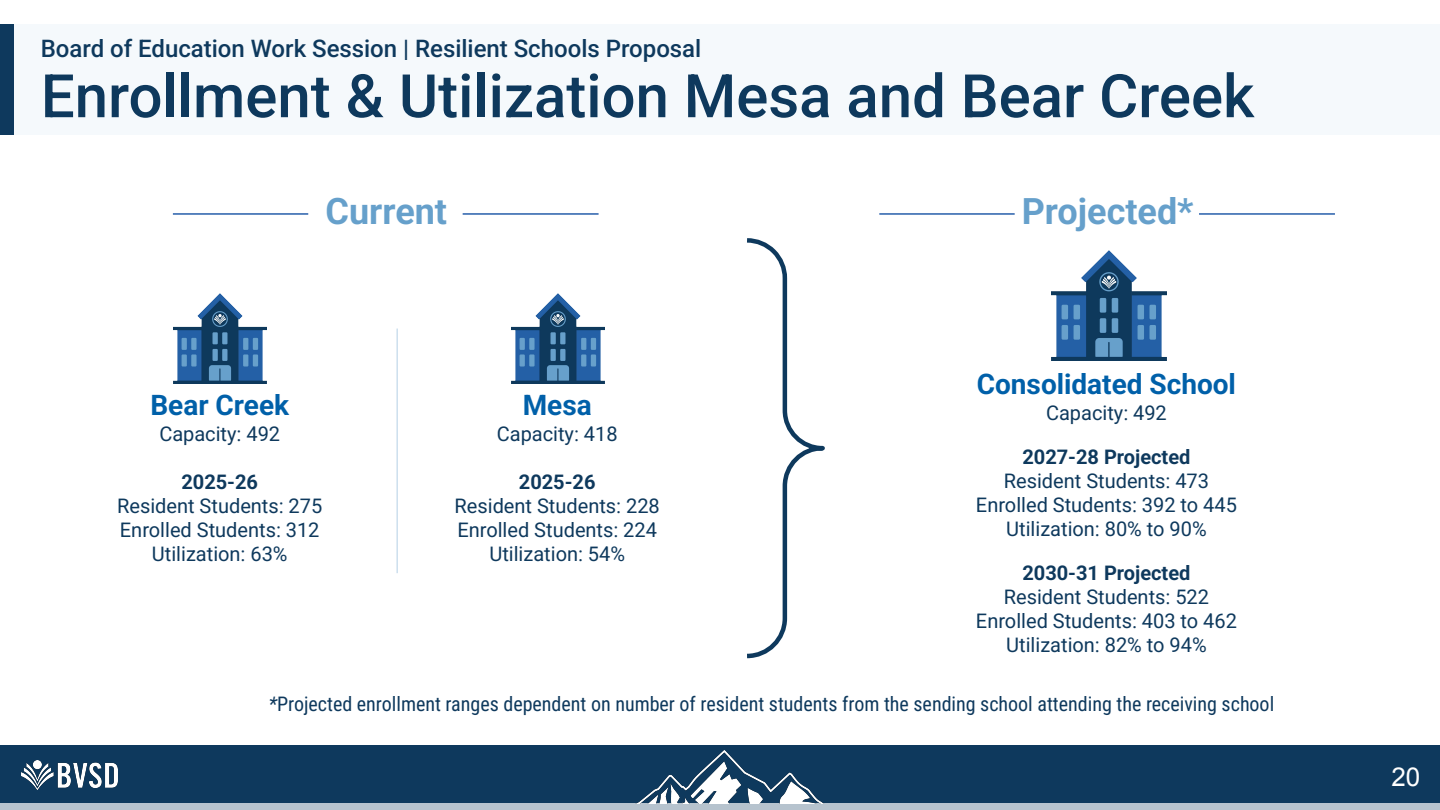
Slide 30: Preliminary facility costs